Dr. Abel Gunn
Physician and First Recorder of Derby
Dr. Abel Gunn (1643–1688)
Physician and First Recorder of Derby
Born: Before 19 June 1643, Milford, New Haven Colony
Baptized: 19 June 1643, First Church of Milford
Married: Mary Smith, 29 October 1667, Milford
Died: 1688, Derby, Connecticut Colony
Burial: Probably Old Derby Uptown Burying Ground, Derby; no burial record or surviving gravestone has been identified
Dr. Abel Gunn belonged to the first generation of the Gunn family born in America. He was born at Milford, probably only a short time before his baptism there on 19 June 1643. His father, Dr. Jasper Gunn, had helped establish the settlement at Wepawaug only a few years earlier.1 Abel inherited neither an old profession nor a settled town. Both had to be built in the uncertain conditions of colonial New England.
Later genealogical and local histories identify Abel as a physician at Derby. The surviving record of his public life is fuller in another direction. For more than twenty years he kept the records of the settlement first called Paugassett and later Derby. He measured land, recorded births and marriages, preserved town votes, represented his neighbors in transactions, and helped define the boundaries of communities that were still taking shape.
His life was brief. He died in 1688 at about forty-five, leaving no children. Yet Abel’s surviving work is unusually tangible. Derby’s earliest record books were kept principally in his hand.
A Child of Milford
Abel was a son of Jasper Gunn and Jasper’s later wife, Christian Gunn. His mother’s maiden name remains unproved, and the appearance of the name “Mary” in a Milford church entry is part of the unresolved problem surrounding Jasper’s wives. Christian’s 1690 will, however, names Jasper’s known children as her own and provides the strongest evidence for Abel’s place in her household.2
Abel grew up in a family for which useful knowledge carried public obligations. Jasper practiced medicine, taught Milford’s first school, repaired metal vessels, served as sealer of weights and measures, operated the Hartford mill, and held responsibilities in the church and town. Abel would follow the same broad pattern. He became known as a physician, but he also made himself useful wherever literacy, accuracy, judgment, and trust were required.
No record has been found of Abel attending a college or completing a formal medical apprenticeship. In seventeenth-century New England, medical knowledge was commonly transmitted through private reading and apprenticeship rather than through a medical school. It is reasonable to believe that Abel learned from Jasper’s books, remedies, and practice, but that conclusion remains an inference. Unlike Jasper, whose colonial license to practice “physisicke” survives, no separate medical license, patient ledger, or collection of remedies has yet been located for Abel.3
The title “Dr. Abel Gunn,” therefore, rests upon the consistent identification of him as a physician in later genealogical and local accounts. The records establish his education and competence indirectly: he was one of the men trusted to create, preserve, and interpret the written record of a new town.
Marriage to Mary Smith
On 29 October 1667, Abel married Mary Smith of Milford.4 Mary had been baptized there on 7 January 1648. She was the daughter of Sergeant John Smith and his wife, Grace, early members of the Milford community. Grace has often been assigned the maiden name Hawley, but published genealogical research has not established that surname from a contemporary record.5
The marriage joined Abel to a family already invested in the land at Paugassett. John Smith was one of the original proprietors of the tract. In 1668 he transferred his right in the Derby lands to Mary and Abel. A later history called Mary the third bride to settle in the young community—a small detail that conveys how new the settlement still was.6
Abel and Mary had no known children. Their household nevertheless stood within a close network of Gunn, Smith, Wooster, Riggs, Johnson, Baldwin, Hawkins, and other families who were turning a scattered settlement along the Naugatuck and Housatonic rivers into an organized town.
From Paugassett to Derby
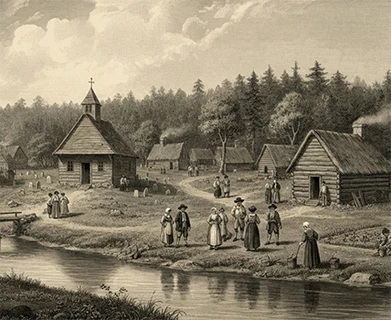
Paugassett began as an outlying settlement claimed through a complicated mixture of colonial grants, private purchases, and agreements with Indigenous proprietors. Edward Wooster established a permanent home there in the 1650s and was soon joined by other families. The distance from Milford gave the settlers room to build, but it also required them to create the machinery of local government for themselves.
In 1666, the proprietors employed Abel Gunn to keep their accounts. The record book he began became the first volume of the Derby town records. A nineteenth-century account observed that the book was written by Abel and that he continued as town clerk or recorder for twenty-one years.7 The office was not ceremonial. The recorder preserved land divisions, debts, agreements, roads, town elections, marriages, births, and other matters upon which ownership and communal memory depended.
The opening entry recounted the earlier sale of the Paugassett tract and described its bounds by rivers, rocks, swamps, brooks, and other features of the landscape. Subsequent pages recorded the practical construction of community. On 4 February 1667, Abel joined six other inhabitants in an agreement concerning the settlement. A record of 15 March lists him among its inhabitants. In December 1677, after Paugassett had received the name Derby, the town again chose “Abell Gun” as recorder.8
The spelling is irregular, the sentences compressed, and the landscape described in terms that belonged to the people who walked it. Yet the importance of the record is unmistakable. Abel did more than witness Derby’s beginning. He gave that beginning a written form.
The Record in His Hand
The physical evidence of Abel’s work has not disappeared. In 1901, the Sarah Riggs Humphreys Chapter of the Daughters of the American Revolution published a transcription of Derby’s surviving records from 1655 through 1710. Nancy O. Phillips copied the volumes and compared her work with the originals, preserving their spelling, capitalization, and punctuation. The resulting book is now available digitally and gives modern readers direct access to the records Abel kept.7
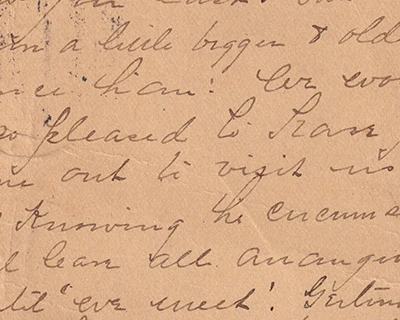
The publication also preserves a single photographic facsimile of the deteriorated manuscript: page 41 of “Book A I, Derby and Pagassett Records.” The page contains Abel’s copy of Connecticut General Court actions concerning Paugassett, including the 1675 order by which the settlement received the name Derby. The words originated with the colonial government, but the surviving page appears to preserve the hand of the town recorder who entered them into Derby’s book. Because a formal handwriting comparison has not yet been completed, that attribution should be described as probable rather than absolute.
The next volume supplies more personal evidence. Its opening page bears the inscription, “ABell Gun his Book—1675 May 30.” Elsewhere, after recording the measurements of ten acres laid out for George Beman, the recorder concluded: “p me Abell Gunn being appoynted to lay it out.”7 The words bring Abel unusually close. He had walked the boundaries, measured the land, and then entered the result in the book for the town’s future use.
These records were not private reflections. They were working instruments of government. A boundary written in Abel’s hand could determine possession long after the men who first cleared the land were dead. His pages joined memory to law and transformed agreements made in a small frontier settlement into an enduring public record.
Public Trust and the Shape of the Land
Abel’s responsibilities extended beyond the clerk’s desk. In May 1685, the Connecticut General Court appointed “Abell Gunn of Derby” and John Stanley of Mattatuck to lay out the northern and western boundaries of Woodbury. They were instructed to run a line seven miles west from Woodbury’s northeast corner, then south toward the Potatuck River and Derby’s bounds.9
Boundary work required more than physical endurance. It demanded practical mathematics, familiarity with the terrain, the ability to follow legal instructions, and the confidence of communities whose future property claims would depend upon the result. The appointment is among the strongest evidence of Abel’s standing beyond Derby itself.
On 6 August 1687, Abel acted with Lieutenant Ebenezer Johnson and Edward Wooster as an agent for Derby in a deed for land in the Great Neck. The deed named several Indigenous proprietors and recorded a consideration of twenty-one pounds in “good Indian pay.” It described the land through the Four Mile Brook, Little River, Eight Mile Brook, Potatuck River, and the Woodbury path.10
The document must be read as part of the colonial transfer of Indigenous land into English ownership. It also shows the role Abel occupied near the end of his life. He was not present merely as a private buyer. He represented the town. His work joined literacy, property, law, and public authority at the point where an expanding English settlement converted the landscape into surveyed and recorded possession.
Medicine in a New Settlement
Abel’s designation as a physician places him in the tradition established by his father. Colonial medicine was practiced without hospitals, laboratory tests, or the professional institutions that would later regulate medical education. A physician worked from observation, inherited remedies, printed medical texts, household knowledge, and experience. Treatment took place in homes, and a practitioner often traveled over difficult roads to reach the sick.
There is no surviving evidence detailed enough to reconstruct Abel’s patients or treatments. We should not supply what the record withholds. His residence at Derby, however, placed a medically knowledgeable man within a small and exposed community. Disease, injury, childbirth, and epidemic illness were constant features of colonial life. Even if medicine was not his only occupation—and it rarely was for physicians of the period—his training would have made him valuable to his neighbors.
Abel’s life also demonstrates that the colonial physician could be more than a healer. The habits required by medicine—literacy, careful observation, recordkeeping, and judgment—were equally useful in civic life. His public service did not stand apart from his profession. Both belonged to the same culture of practical responsibility.
Death and Estate
Abel made his will on 11 May 1683. The recorded abstract gives his property to his wife, Mary, and names no children. An inventory was indexed in the New Haven probate records, although the early published researcher who cited it reported that it could not be found at the referenced page.11 Abel died at Derby in 1688, at approximately forty-five years of age. The precise date and cause of his death have not been established.
No contemporary burial record or surviving gravestone has been located for Abel. The probable place of burial is the Old Derby Uptown Burying Ground, now also called the Colonial Cemetery. Derby set aside the ground as a community cemetery shortly after becoming a separate town in 1675, and its oldest surviving marker—that of the Reverend John Bowers—dates from 1687.12 Abel died in Derby the following year and had been one of the town’s principal officers for more than two decades. Burial there is therefore a reasonable conclusion, but it remains circumstantial and should not be stated as proven.
Because the marriage had produced no heirs, the continuation of Abel’s property followed the wider family. Later Derby histories state that his lands ultimately passed to his nephew and namesake, Sergeant Abel Gunn, son of Jobamah Gunn, and that the town confirmed the arrangement in 1709.13 This younger Abel must be distinguished carefully from his uncle; the repeated name has caused confusion in online family trees and derived records.
Mary survived her first husband. On 12 May 1691 she married John Davis of Derby. She made her own will in December 1692 and died at about that time.14
Legacy
Abel Gunn left no descendants, but descent is not the only measure of continuity. He carried into the first American-born generation the pattern already visible in Jasper’s life: knowledge joined to service, and private skill placed at the disposal of the community.
His medical work survives largely through later identification. His civic work survives on the page. Derby’s first record book preserves the acts of settlers dividing land, opening roads, choosing officers, and creating a town from agreements that might otherwise have disappeared. Abel’s handwriting became part of the legal memory of the place.
The Gunn family line continued through his brothers and sister. Abel contributed something different. He helped build the institutional world in which those families could live: a world of recorded rights, defined obligations, public trust, and communal memory. His name did not continue through children of his own, but his hand remains in the record.
Timeline
- 19 June 1643 — Baptized at the First Church of Milford, Connecticut Colony.
- 1666 — Employed by the Paugassett proprietors to keep their accounts; began the volume that became Derby Town Records, Volume I.
- 4 February 1667 — Named among seven inhabitants entering an agreement for Paugassett.
- 29 October 1667 — Married Mary Smith at Milford.
- 1668 — Received, with Mary, her father John Smith’s proprietary right in Derby lands.
- 13 May 1675 — Paugassett was formally named Derby by the Connecticut General Court.
- 20 December 1677 — Chosen recorder at a Derby town meeting.
- 11 May 1683 — Made his will, leaving his property to Mary and naming no children.
- May 1685 — Appointed by the General Court to help lay out the northern and western boundaries of Woodbury.
- 6 August 1687 — Served as one of Derby’s agents in the Great Neck land deed.
- 1688 — Died at Derby, approximately forty-five years old; probably buried in the Old Derby Uptown Burying Ground, although no individual burial record or gravestone has been found.
Family
Parents
- Dr. Jasper Gunn (1607–1670/71) — Physician, teacher, deacon, and early settler of Milford.
- Christian Gunn (d. 1690) — Jasper’s widow and the woman whose will identifies his known children as her own. Her maiden name has not been proved.
Wife
- Mary Smith Gunn Davis (1648–c. 1692) — Daughter of Sergeant John Smith and Grace Smith of Milford; married Abel in 1667 and, after his death, John Davis in 1691.
Children
Abel and Mary had no known children. Abel’s will names no children, and the later transfer of his Derby property to his nephew is consistent with a childless marriage.
Siblings
Abel belonged to the family of Jasper and Christian Gunn that included Nathaniel, Jobamah, Daniel, Samuel, and Mehitable Gunn. The exact birth order reported in later genealogies varies because several early dates are reconstructed from incomplete records.
Related Articles
- Jasper Gunn
- Christian Gunn
- The Founding of Milford — planned article
- Paugassett Becomes Derby — planned article
- Medicine in Seventeenth-Century New England — planned article
Sources and Further Reading
- Derby (Conn.), Town Records of Derby, Connecticut, 1655–1710, copied and compared with the original by Nancy O. Phillips (New Haven: Tuttle, Morehouse & Taylor, 1901); digital scan at Internet Archive.
- Samuel Orcutt and Ambrose Beardsley, The History of the Old Town of Derby, Connecticut, 1642–1880 (Springfield, Mass.: Springfield Printing Company, 1880).
- William Cothren, History of Ancient Woodbury, Connecticut, vol. 2 (Woodbury, Conn.: William Cothren, 1872).
- Donald Lines Jacobus, “John Smith of Milford, Conn.,” The American Genealogist 25 (1949): 122–27.
- Susan Woodruff Abbott, Families of Early Milford, Connecticut (Baltimore: Genealogical Publishing Company, 1979), 316–18, 653.
- Morris W. Abbott, Medical Men of Milford (Milford, Conn.: Milford Medical Society, 1965).
- Robert S. Grumet, “Indian Deeds and Land Transactions in Colonial Connecticut,” Northeast Anthropology 70 (2005): 29–42.
- “Olde Derby Uptown Burial Ground,” Our Valley CT; “Oak Cliff Cemetery Association Fund,” Valley Community Foundation.
Research Notes
- Medical career. Published genealogical and local sources call Abel a physician at Derby, but this research did not locate a colonial medical license, a medical account book, or a contemporary record of a particular patient or treatment. The biography retains his traditional title while avoiding unsupported details about his practice.
- Medical education. No college attendance or formal apprenticeship record has been found. Training under his father is plausible but presently unproved.
- Marriage year. The stronger published genealogical evidence gives 29 October 1667. Some derivative sources give 1666; the original Milford entry should be inspected before final publication.
- Will date. Donald Lines Jacobus’s account gives 11 May 1683 and cites New Haven Probate Records, volume 2, page 7. Some derivative accounts give 1688, apparently conflating the will with Abel’s death year. The digitized image of the original probate volume should be inspected before the date is treated as finally verified.
- Death date. The year 1688 is consistently reported. An exact day has not been established here. Online trees that give 14 March or 11 May as the day of death should not be followed without the underlying record.
- Burial. The Old Derby Uptown Burying Ground is the probable burial place because it was Derby’s community cemetery when Abel died. No burial entry or surviving stone has been found for him, so the location remains unconfirmed.
- Mother’s identity. Christian Gunn is treated as Abel’s mother on the evidence of the Gunn family wills. “Baldwin” is not used as her maiden name because no contemporary record has been found that gives Jasper’s wife that surname.
- Nephew and heir. Abel’s namesake nephew, son of Jobamah Gunn, later lived at Derby and inherited his uncle’s property. Records after 1688 referring to Abel Gunn normally concern the nephew or a later namesake.
- Handwriting attribution. The 1901 edition reproduces a facsimile of page 41 of Book A I and identifies Book 2 with Abel’s ownership inscription. Abel’s long service as recorder makes attribution of the facsimile handwriting to him highly probable, but a formal comparison with independently authenticated examples has not yet been made.
Footnotes
-
First Church of Milford baptismal record, 19 June 1643, as abstracted in Susan Woodruff Abbott, Families of Early Milford, Connecticut (Baltimore: Genealogical Publishing Company, 1979), 318. ↩
-
Will of Christian Gunn of Milford, dated 6 May 1690, proved 1 December 1690, New Haven probate records; see also Abbott, Families of Early Milford, 316–18. ↩
-
Morris W. Abbott, Medical Men of Milford (Milford, Conn.: Milford Medical Society, 1965); Susan Woodruff Abbott, Families of Early Milford, 316–18. Jasper Gunn’s license was granted by the Connecticut General Court on 21 May 1657. ↩
-
Donald Lines Jacobus, “John Smith of Milford, Conn.,” The American Genealogist 25 (1949): 122–27. Some derivative accounts give 1666; see Research Notes. ↩
-
Susan Woodruff Abbott, Families of Early Milford, 653. ↩
-
Samuel Orcutt and Ambrose Beardsley, The History of the Old Town of Derby, Connecticut, 1642–1880 (Springfield, Mass.: Springfield Printing Company, 1880), genealogical section under Gunn and Smith families. ↩
-
“The Wooster Family,” The New York Genealogical and Biographical Record 30 (1899): 244–45; Derby (Conn.), Town Records of Derby, Connecticut, 1655–1710, copied and compared with the original by Nancy O. Phillips (New Haven: Tuttle, Morehouse & Taylor, 1901), frontispiece, 3, 36, 43. The 1901 volume identifies its frontispiece as a facsimile of page 41, Book A I; page 43 begins, “ABell Gun his Book—1675 May 30”; and page 36 prints the Beman survey entry ending “p me Abell Gunn being appoynted to lay it out.” ↩ ↩2 ↩3
-
Town Records of Derby, 8–9, 32. ↩
-
William Cothren, History of Ancient Woodbury, Connecticut, vol. 2 (Woodbury, Conn.: William Cothren, 1872), 52–54; Connecticut General Court order, May 1685. ↩
-
Derby Great Neck deed, 6 August 1687, transcribed in Robert S. Grumet, “Indian Deeds and Land Transactions in Colonial Connecticut,” Northeast Anthropology 70 (2005): 29–42. ↩
-
New Haven Probate Records, vol. 2, 7, will of Abell Gunn, dated 11 May 1683; abstracted in Donald Lines Jacobus, “John Smith of Milford, Conn.,” The American Genealogist 25 (1949): 122–27. Jacobus noted that the inventory was indexed to page 11 but was not found there. ↩
-
“Olde Derby Uptown Burial Ground,” Our Valley CT; Valley Community Foundation, “Oak Cliff Cemetery Association Fund”; see also the cemetery history identifying the Reverend John Bowers’s 1687 marker as the oldest surviving stone. ↩
-
Orcutt and Beardsley, History of the Old Town of Derby, genealogical section under Gunn; Town Records of Derby, town action of 1709 concerning the younger Abel Gunn. ↩
-
Jacobus, “John Smith of Milford,” 122–27; Derby vital and town records, marriage of Mary Gunn and John Davis, 12 May 1691. ↩