
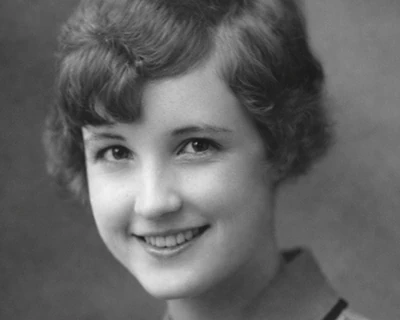
Christian Gunn
Founding mother of the Gunn family in America — her life, her will, and the generations she set in motion.
Family
- SpouseJasper Gunn
Among the earliest members of the Gunn family in New England, few played a more important role than Christian Gunn, wife of Dr. Jasper Gunn (1607–1670/71) of Milford, Connecticut. Though surviving records reveal only fragments of her life, those fragments tell the story of a young Englishwoman who crossed the Atlantic during the Great Migration, helped establish a household in a frontier settlement, raised a family that endured for generations, and became the matriarch of one of the earliest Gunn families in colonial New England.
Like many women of the seventeenth century, Christian appears only briefly in official records. Yet her influence can be measured in the family she helped build, the values she transmitted, and the generations that followed. She was not merely the wife of Jasper Gunn; she was his partner in the creation of a new life in America.
A note on her name: the woman who left England with Jasper Gunn is documented, in her own 1690 will, as Christian Gunn of Milford. That is the name used throughout this account. Her maiden name is not established by any surviving record, and the identification of her English family — discussed below — is a proposed one rather than a documented fact.
Origins in Buckinghamshire
Christian’s maiden name and English origins are not fixed by direct record. The leading identification proposed by researchers connects her to a Christian Baldwin, baptized on 17 January 1615/16 in the parish of Cholesbury, Buckinghamshire, England, daughter of Richard Baldwin (1576–1633) and Isabell Harding (c. 1577–1633). The connection rests on inference — the coincidence of name, place, timing, and the presence of Baldwin relatives around the Gunn household in New England — rather than on any document naming Jasper’s wife as a Baldwin. It should be read as a well-supported hypothesis, not a proven fact.
In that identification, the Baldwin family lived in the Chiltern Hills northwest of London, a region of villages, farms, and cottage industries. Richard Baldwin was a weaver, an occupation that placed the family among England’s respectable “middling sort” — artisans, tradesmen, and small property holders who formed the backbone of rural society.
The counties surrounding London, including Buckinghamshire, Essex, and Hertfordshire, produced a disproportionate number of the families who later migrated to New England during the Puritan migration of the 1630s. The proposed Baldwin origin would place Christian in a large family that included brothers Timothy Baldwin, Nathaniel Baldwin, and Joseph Baldwin, all of whom appeared among the early settlers of Milford, along with a sister, Sarah Baldwin. The concentration of these Baldwins in the same New England communities is the strongest circumstantial support for the identification.
Marriage to Dr. Jasper Gunn
The exact date of Christian’s marriage to Dr. Jasper Gunn is unknown, but surviving evidence narrows the timeframe considerably.
Richard Baldwin’s will, written in 1630 and proved on 16 May 1633, identified his daughter as an unmarried “Christian Baldwin” — one link in the chain that supports the proposed identification. By July 1635, Jasper Gunn departed England aboard the ship Defence accompanied by a woman recorded on the passenger list as “Anna Gunn.” Most researchers conclude that this woman was Jasper’s wife, Christian — the passenger-list “Anna” being one of the several name variants that attach to her.
If the identification holds, the marriage occurred sometime between 1633 and the summer of 1635, when Christian was approximately nineteen.
The match appears consistent with the backgrounds of both families. Like the Baldwins, the Gunns emerged from a culture of literacy, Protestant religious conviction, and social responsibility.
Crossing the Atlantic
In July 1635 Christian left England aboard the Defence bound for New England.
The journey represented far more than a change of residence. She was leaving behind family, familiar landscapes, and the social world that had shaped her childhood. Life aboard ship was cramped and often uncomfortable — passengers spent weeks living among chests, bedding, and provisions while enduring uncertain weather and the hardships of ocean travel.
For Christian, the voyage marked the beginning of a life that would unfold entirely within the emerging society of colonial New England.
Roxbury and Milford
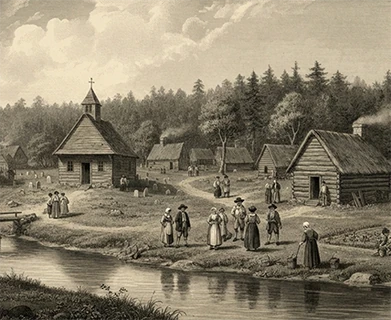
By 1638 the Gunn household — and the families associated with it — were living in Roxbury, Massachusetts Bay Colony, alongside several of the Baldwin relatives whose presence anchors the proposed identification.
Within a year many of these same families relocated again, joining the congregation led by Reverend Peter Prudden in the founding of Milford in the New Haven Colony. The concentration of Baldwin relatives in Milford strongly suggests that Christian and Jasper were part of a larger family migration network rather than isolated emigrants.
Milford would remain their home for the rest of their lives.
Building a Household in New England
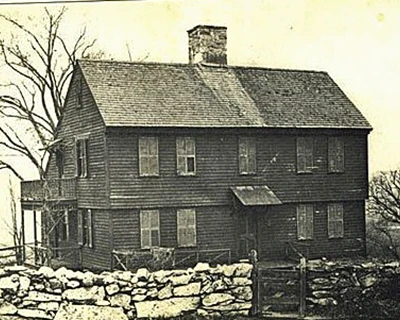
The success of early New England settlements depended not only upon ministers, magistrates, and landowners but also upon the women who maintained households and raised families. Puritan writers often described the home as a “little commonwealth.” Within that sphere women managed food preparation, clothing production, child care, religious instruction, and the countless tasks necessary to sustain family life.
Christian spent most of her adult life within this environment. Though official records seldom document her daily activities, her labor formed part of the foundation upon which Milford was built. Within the Gunn household children learned to read, absorbed the religious culture of the colony, and inherited the habits of discipline and responsibility that would characterize later generations of the family.
Children of Jasper and Christian Gunn
Jasper and Christian Gunn were the parents of several children who carried the Gunn family into the next generation of colonial New England.
Nathaniel Gunn (1637–1663)
Nathaniel married Sarah Day (1640–1677) and settled in Branford, Connecticut. Though he died at only twenty-six years of age, his descendants continued one of the earliest Gunn lines in New England.
Jobamah Gunn (1640–1711)
Jobamah married Mary Smith (1643–1715) and became one of the principal continuers of the Gunn family line. Many later Gunn descendants trace their ancestry through Jobamah and Mary.
Samuel Baldwin Gunn (1642–1718)
Samuel remained closely connected to Milford and later served as executor of his mother’s estate. His middle name — Baldwin — is itself part of the evidence for his mother’s proposed family, preserving a Baldwin connection within the Gunn household.
Dr. Abel Gunn (1643–1688)
Like his father, Abel became a physician. He married Mary Smith (1648–1691) and practiced medicine in Milford. Although Abel and Mary left no known children, he continued the family’s tradition of public service and medical practice.
Daniel Gunn (1645–1711)
Daniel married Deborah Coleman (1645–1703). Daniel and Deborah left no known children.
Mehitable Gunn
Mehitable married first Benjamin Fenn and later John Camp. Through her children she carried the Gunn family heritage into several prominent Connecticut lines.
Christian Gunn’s Will
The single most revealing document associated with her is her will, dated 6 May 1690 — and it is the anchor for the name used throughout this account.
In it she identified herself simply as “Christian Gunn of Milford.” This matters, because later records and genealogies sometimes call her “Mary Gunn” or “Mary Christian Gunn.” Her own testamentary language settles the question of what she was called: Christian Gunn.
The will names her surviving children and numerous grandchildren, providing a valuable snapshot of the family more than fifty years after its arrival in New England. Among the most meaningful bequests were Bibles left to her grandsons Benjamin and Joseph Fenn — gifts that reflected the religious culture that had shaped her life from childhood and suggest a desire to pass those values to another generation.
By 1690 Christian had become the matriarch of a large extended family whose members were spread across several Connecticut communities.
The Question of Her Name
Few figures in the early Gunn record appear under as many names as Jasper Gunn’s wife. Surviving and derived records call her:
- Christian Baldwin — the name of the Cholesbury woman in the proposed identification
- Anna Gunn — the rendering on the 1635 Defence passenger list
- Christian Gunn — her own name in her 1690 will
- Mary Gunn / Mary Christian Gunn — in later records and genealogies
The documented anchor is her will: Christian Gunn. The appearance of “Mary” in later sources is most plausibly a later error or the accretion of a secondary name by descendants, and it is not supported by any record in her lifetime. “Anna” is best understood as a variant or clerical form on the passenger list. “Baldwin,” finally, is not a name any record attaches to Jasper’s wife directly; it is the maiden surname of the woman researchers propose to identify her with. This account therefore calls her Christian Gunn throughout, treats the Baldwin origin as a hypothesis, and does not assert a maiden name the documents do not give her.
Legacy
The surviving records tell us little about Christian Gunn’s personality, thoughts, or private experiences. Such silence is common for women of the seventeenth century. Yet her influence can be seen in the generations that followed.
The Gunn family she helped establish produced physicians, ministers, teachers, soldiers, reformers, writers, educators, and civic leaders. Through the descendants of Nathaniel, Jobamah, Samuel, and Mehitable Gunn, the values of literacy, discipline, religious devotion, and family responsibility continued to appear throughout later generations of the Gunn family.
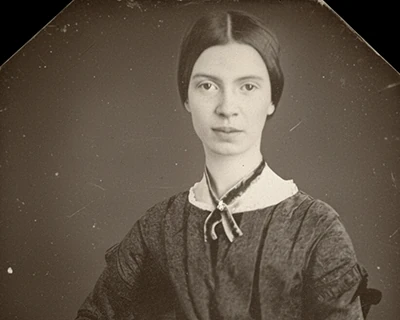
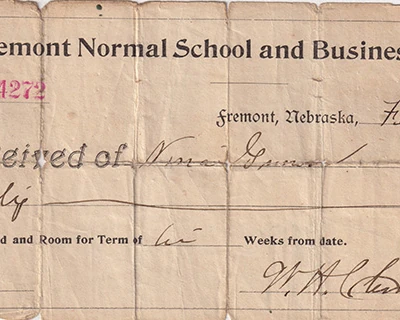
The lives of later Gunn women — including Elizabeth “Lizzie” Gunn, Abigail Florence Gunn Baker, Nina Belle Gunn, and even the family’s connection to Emily Dickinson — suggest that the habits of literacy, reflection, and quiet leadership remained part of the family’s inheritance for centuries.
Christian Gunn was not a peripheral figure in the family story but one of its founders. Like her husband, she carried an invisible cargo across the Atlantic — faith, courage, industry, and the disciplined habits of a household culture that would shape the Gunn family for generations to come.
Sources & Notes
- Cholesbury Parish Register, Buckinghamshire, England — baptism of Christian Baldwin, 17 January 1615/16 (basis of the proposed identification)
- Richard Baldwin, will dated 23 December 1630, proved 16 May 1633, Archdeaconry Court of Buckingham; transcribed in Charles Candee Baldwin, The Baldwin Genealogy from 1500 to 1881 (Cleveland, 1881), 991
- John Camden Hotten, ed., The Original Lists of Persons of Quality (London: Chatto and Windus, 1874), 116
- David Hackett Fischer, Albion's Seed: Four British Folkways in America (New York: Oxford University Press, 1989), 16–25
- Virginia DeJohn Anderson, New England's Generation (Cambridge University Press, 1991), 89–114
- History of Milford, Connecticut 1639–1939 (Bridgeport, CT: Milford Tercentenary Committee, 1939)
- Will of Christian Gunn, Milford, Connecticut Colony, dated 6 May 1690; full transcription published in the Gunns in America Archive