Daniel Gunn
A Landholder of Milford's Second Generation
Daniel Gunn (1645–c. 1690)
Biography
Daniel Gunn belonged to the first generation of the Gunn family born in New England. He was a son of Jasper Gunn, the physician, teacher, mill operator, and founding free-planter whose movements carried the family from Roxbury to Milford, Hartford, and eventually back to Milford. Daniel’s mother was Christian Gunn, whose surname before marriage remains unproved.
The surviving record of Daniel’s life is limited, but it is not empty. It places him within the church, land, political, and household structures by which a colonial settlement became a durable town. Daniel did not hold the public prominence of his father, nor did he establish a continuing family line. His importance lies in the work of continuity: receiving land, managing a household economy, accepting responsibility for his widowed mother, and taking his place among Milford’s recognized citizens.
Birth and Childhood
Older Gunn genealogies commonly place Daniel’s birth at Roxbury in 1639. No contemporary birth record has been found to support that date. The surviving Milford church record states that Daniel was baptized there in September 1645. Robert Charles Anderson’s Great Migration study accepts the baptismal entry and does not assign him the earlier birth date.1
Daniel was therefore probably born at Milford shortly before his baptism, although the record establishes only the baptism itself. Jasper and his family moved to Hartford about 1647, when Daniel was still a small child. There Jasper practiced medicine and operated the town mill. By 1661 the family had returned to Milford, where Daniel entered adulthood.
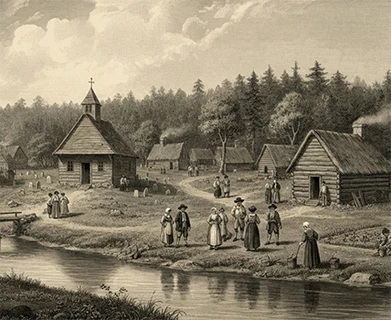
His childhood was divided between two of Connecticut’s early communities. Hartford was already becoming an important center of colonial government and commerce. Milford remained a smaller settlement organized around its church, fields, common land, harbor, and the Wepawaug River. Daniel’s adult life would be rooted in Milford.
Marriage to Deborah Coleman
Daniel married Deborah Coleman, daughter of Thomas Coleman and Frances Albright Coleman. Deborah was probably born about 1640. Her father had lived at Wethersfield, represented that town in the Connecticut General Court, and later became one of the early settlers of Hadley, Massachusetts.2
No contemporary marriage entry for Daniel and Deborah has been located. Clarence Almon Torrey’s New England Marriages Prior to 1700 places the marriage at about 1672 and associates it with Hatfield. Later researchers have questioned whether that date may be slightly early. The responsible conclusion is that Daniel and Deborah married sometime in the early or middle 1670s, while leaving the precise date and place unresolved.3
The marriage is independently confirmed by Deborah’s later identity. In her will, dated December 2, 1703, she called herself “Deborah Gunn of Milford.” Daniel and Deborah had no known children. Her will directed property toward her Coleman relatives rather than toward descendants, supporting the conclusion that the marriage was childless.4
Land and Livelihood
No surviving record identifies Daniel as a physician, craftsman, merchant, or practitioner of another specialized trade. The evidence instead points toward the ordinary but essential work of a seventeenth-century Connecticut landholder: cultivating fields, cutting hay, tending livestock, maintaining fences, and participating in the shared obligations attached to property.
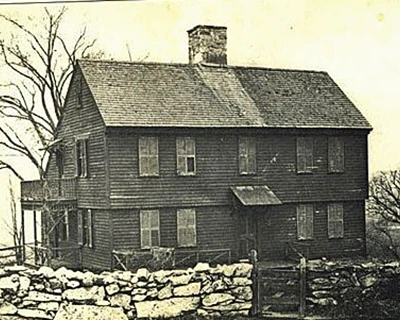
Jasper Gunn’s will, written on December 25, 1670, placed Daniel near the center of the family’s working estate. Daniel received half of his father’s lands and meadows, apart from specifically reserved parcels, and a portion of the family homelot. Daniel and his brother Samuel were also to divide Jasper’s cattle, horses, cart, and implements. Jasper named the two sons his executors and charged them with providing their mother a home and continuing support.5
These provisions show more than inheritance. Daniel was entrusted with productive land, animals, equipment, the execution of his father’s estate, and the welfare of his mother. He was already considered capable of managing both property and obligation.
Milford’s land records confirm his independent standing. Daniel held a first half-division in the Ferry Corner, described as five acres with additional acreage allowed to equalize its value, amounting to approximately twelve acres. His second half-division consisted of approximately six acres on the town plain near Four Mile Meadow.6
Landholding in colonial Milford was inseparable from community responsibility. Fields and meadows required common fences, roads, gates, drainage, and agreed boundaries. Property owners paid town and colony rates and depended upon their neighbors to maintain the larger system. Daniel’s work cannot be reconstructed field by field, but the lands, livestock, cart, and implements recorded in the family estate identify the material world in which he labored.
A Freeman of Connecticut
On May 11, 1671, only months after his father’s death, Daniel was among the Milford men “propownded for freemen” before the Connecticut General Court. His brother Samuel appeared in the same group.7
The record establishes Daniel’s nomination rather than documenting the final admission ceremony. Even so, being propounded carried civic meaning. Freeman status brought participation in the colony’s political life and was ordinarily extended to men accepted as settled and responsible members of their communities. Daniel’s appearance on the list shows that Milford recognized him as more than Jasper Gunn’s son. He had become a householder with a place of his own in the town.
A smaller glimpse of Daniel’s standing may survive in a Stratford land transaction dated May 17, 1675. A “Daniel Gun” witnessed a deed from Thomas Sherwood to John Burritt. The proximity of Stratford to Milford makes identification with Daniel plausible, although the record does not provide enough detail to make it certain.8 If the witness was Daniel, the entry places him within the regional network of property and legal transactions that joined neighboring towns.
Death and Burial
Daniel died about 1690, probably at Milford. No surviving record presently establishes the exact date or cause of his death. Modern genealogical scholarship accepts the approximate year, but it should not be presented as a documented day or even as an unquestionably exact year.9
No securely identified burial entry or gravestone has been found. Daniel was probably buried in Milford’s early burying ground, where members of his family and community were laid to rest, but the location remains unproved.
Deborah survived him and remained in Milford until her death in December 1703. Because they had no known children, Daniel established no continuing branch of the Gunn family. His property passed through other family and collateral relationships rather than through descendants of his own.
The Work of Continuity
Daniel Gunn left no dramatic public career and no descendants to carry his name through a separate line. Yet the surviving evidence reveals a recognizable and necessary life. He inherited and worked the land his father had helped secure, assumed responsibility for his widowed mother, entered the political body of Connecticut as a prospective freeman, and participated in the economic life of Milford.
The first generation founded the settlement. Daniel’s generation made it durable. Through fields cultivated, livestock maintained, property recorded, and obligations honored, men and women such as Daniel and Deborah converted a precarious colonial beginning into an established community.
Daniel’s life belongs to the quieter history of America. Communities are remembered through founders, ministers, magistrates, and soldiers, but they endure through people whose labor seldom produces a title. Daniel carried forward what the founding generation had begun. That was his contribution to Milford, and it was enough.
Timeline
- September 1645 — Baptized at Milford, Connecticut Colony; probably born there shortly before the baptism.
- About 1647 — Moved with the Gunn family from Milford to Hartford.
- By 1661 — Returned with the family to Milford.
- 25 December 1670 — Named in Jasper Gunn’s will; inherited land, meadow, livestock, and working equipment with his brother Samuel and was appointed a coexecutor.
- 11 May 1671 — Propounded for freeman with other Milford men before the Connecticut General Court.
- Early to middle 1670s — Married Deborah Coleman; the exact date and place remain unproved.
- 17 May 1675 — A “Daniel Gun,” probably Daniel of Milford, witnessed a Stratford deed.
- Late seventeenth century — Held divided lands in Milford’s Ferry Corner and near Four Mile Meadow.
- About 1690 — Died, probably at Milford; the exact date and burial place have not been found.
- 2 December 1703 — Deborah Gunn of Milford made her will.
- December 1703 — Deborah died at Milford.
Family
Parents
- Dr. Jasper Gunn (1607–1670/71) — Physician, teacher, mill operator, deacon, and founding free-planter of Milford.
- Christian Gunn (d. 1690) — Jasper’s widow and the woman whose will identifies his known children as her own. Her maiden name has not been proved.
Wife
- Deborah Coleman Gunn (c. 1640–1703) — Daughter of Thomas Coleman and Frances Albright Coleman; married Daniel in the early or middle 1670s.
Children
Daniel and Deborah had no known children. The absence of children in the surviving genealogical and probate evidence supports the conclusion that their marriage produced no issue.
Siblings
Daniel belonged to the family of Jasper and Christian Gunn that included Nathaniel, Jobamah, Mehitable, Abel, and Samuel Gunn. Exact birth orders reported in older genealogies vary because several early dates were reconstructed from incomplete records.
Related Articles
- Jasper Gunn
- Christian Gunn
- The Founding of Milford — planned article
- Milford’s Second Generation — planned article
- Chapter 7: The First American Generation — companion book chapter
Sources & Further Reading
- Robert Charles Anderson, The Great Migration: Immigrants to New England, 1634–1635, vol. 3, G–H (Boston: New England Historic Genealogical Society, 2003), 167–71.
- Susan Woodruff Abbott, Families of Early Milford, Connecticut (Baltimore: Genealogical Publishing Company, 1979), 316–19.
- Clarence Almon Torrey, New England Marriages Prior to 1700, entry for Daniel Gunn and Deborah Coleman.
- Douglas Richardson, “The Widow Frances (Albright) Wells, Wife of Thomas Coleman of Wethersfield and Hadley,” New England Historical and Genealogical Register 146 (1992): 28–34.
- Connecticut, The Public Records of the Colony of Connecticut, General Court proceedings, May 11, 1671.
- Milford, Connecticut, Milford Third Book of Records, land divisions for Daniel Gunn.
- New Haven Probate Records, vol. 1, part 2, 35, will of Jasper Gunn, December 25, 1670.
- Charles C. Baldwin, The Candee Genealogy: With Notices of Allied Families of Allyn, Catlin, Cooke, Mallery, Newell, Norton, Pynchon, and Wadsworth (New Haven: Tuttle, Morehouse & Taylor, 1882), citing Stratford Land Records, vol. 1, 69.
Research Notes
- Birth year. The frequently repeated 1639 birth at Roxbury is not supported by a known contemporary record. Milford Church Records place Daniel’s baptism in September 1645. The website should use 1645 while describing it precisely as a baptism year.
- Birthplace. Milford is probable because the baptism occurred there and Jasper Gunn’s family was living there during this period. The church entry itself records the baptism, not a separate birth event.
- Marriage. The marriage to Deborah Coleman is established, but an original marriage entry has not been found. Torrey gives about 1672 and associates the marriage with Hatfield. The biography uses the broader “early or middle 1670s” until a primary record is located.
- Occupation. No contemporary source found in this research gives Daniel a specialized occupation. His inheritance and land records support describing him as a landholder engaged in the agricultural household economy. “Farmer” is reasonable as a general description but should not be presented as a recorded occupational title.
- Freeman status. The General Court record says Daniel was “propownded for” freeman. This establishes nomination but does not, by itself, document the date of his final admission.
- 1675 deed witness. The Stratford record names “Daniel Gun.” Identification with Daniel of Milford is plausible but not conclusive, so the narrative preserves the qualification.
- Death. The death year of about 1690 is accepted in modern genealogical treatments, but no exact death or probate entry for Daniel was located. The year should remain qualified with “about” or “circa.”
- Burial. No burial entry or surviving stone has been identified. Milford is probable but unproved.
- Children. Daniel and Deborah are consistently reported as having no issue. Deborah’s 1703 will names Coleman relatives rather than children and supports that conclusion.
- Website correction. Any existing reference to Daniel Gunn (1645–1711) should be changed to Daniel Gunn (1645–c. 1690). The 1711 death year is not supported by the sources reviewed and may reflect confusion with another man of the same name.
Endnotes
Footnotes
-
First Church of Milford baptismal record, September 1645, cited in Robert Charles Anderson, The Great Migration: Immigrants to New England, 1634–1635, vol. 3, G–H (Boston: New England Historic Genealogical Society, 2003), 168. Anderson renders the entry “bp. Milford [blank] [blank] 1645” and cites Milford Church Records, 3. ↩
-
Douglas Richardson, “The Widow Frances (Albright) Wells, Wife of Thomas Coleman of Wethersfield and Hadley,” New England Historical and Genealogical Register 146 (1992): 28–34, especially 34. ↩
-
Clarence Almon Torrey, New England Marriages Prior to 1700, entry for Daniel Gunn and Deborah Coleman. Torrey gives Hatfield and about 1672; the exact record underlying that estimate should be inspected before either detail is treated as certain. ↩
-
Will of Deborah Gunn of Milford, dated December 2, 1703, New Haven probate records; cited in Anderson, Great Migration, 3:168. See also Richardson, “Widow Frances (Albright) Wells,” 34. ↩
-
Will of Jasper Gun of Milford, dated December 25, 1670, proved January 27, 1670/71, New Haven Probate Records, vol. 1, part 2, 35. Jasper left Daniel half of his lands and meadows, subject to stated exceptions; divided cattle, horses, cart, and implements between Daniel and Samuel; appointed them executors; and provided for their mother’s continued residence and support. ↩
-
Milford, Connecticut, Milford Third Book of Records, division lands, entries for Daniel Gunn’s first and second half-divisions, transcript at City of Milford. Because the available online text is an automated transcription of difficult seventeenth-century handwriting, the manuscript images should be checked before quoting boundary language verbatim in a final scholarly edition. ↩
-
Connecticut General Court, May 11, 1671, list of Milford men “propownded for freemen,” in The Public Records of the Colony of Connecticut. The list includes both Daniel and Samuel Gunn. ↩
-
Charles C. Baldwin, The Candee Genealogy (New Haven: Tuttle, Morehouse & Taylor, 1882), citing Stratford Land Records, vol. 1, 69, deed from Thomas Sherwood to John Burritt, witnessed by Zaccheus Canby and Daniel Gun, May 17, 1675. ↩
-
Richardson, “Widow Frances (Albright) Wells,” 34, identifies Daniel as baptized in 1645 and deceased about 1690. No exact death entry or gravestone was located in the sources reviewed. ↩