
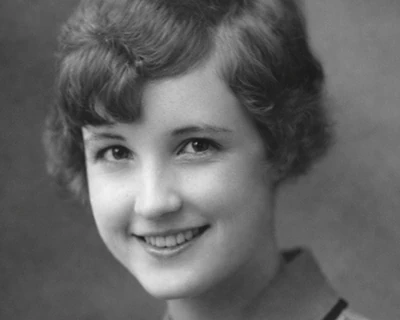
Dorothy Marsh Gunn (1723–1805)
From the Colonial Frontier to the American Republic
- Born: 26 July 1723, Sunderland, Hampshire County, Province of Massachusetts Bay1
- Died: 13 July 1805, Montague, Hampshire County, Massachusetts2
- Parents: Ebenezer Marsh (1687–1747) and Elizabeth Gillett (1689–1753)
- Husband: Lieutenant Nathaniel Gunn (1726–1807)
- Married: 21 March 1745, Sunderland, Massachusetts3
A Daughter of Sunderland
Dorothy Marsh was born on 26 July 1723 in Sunderland, a small settlement on the Connecticut River in western Massachusetts. Her parents, Ebenezer Marsh and Elizabeth Gillett, came from families that had been in New England for several generations. Her father was a farmer and an early settler of the district that became Montague. Her mother belonged to the Gillett family, which had settled in the Connecticut River Valley in the seventeenth century.1
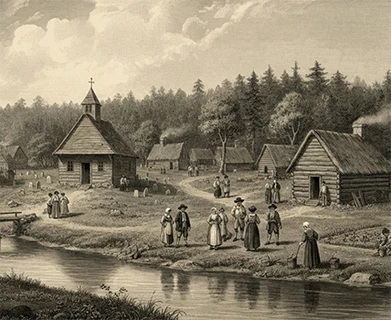
She was born into a settlement still taking shape. The river offered fertile farmland and a route for travel, but the surrounding country was thinly settled by the English. Indigenous peoples had lived in the valley for generations, and their relations with the colonists had been reshaped by decades of trade, disease, territorial expansion, and war. Sunderland had been incorporated only five years before Dorothy’s birth. Its inhabitants were still clearing farms, building roads, and organizing the institutions their community needed, with the meetinghouse at the center of religious and civic life.
Dorothy would spend her entire life in this region, and she would live to see the colony become a republic.
Ebenezer Marsh and the Settlement of Hunting Hills
In 1726 or 1727, when Dorothy was three or four, her father began the venture that secured his place in the history of Montague. Ebenezer Marsh built a small cabin at the southern foot of Taylor Hill, near the property later known as the Nathan Hosmer place, in a district called Hunting Hills, north of Sunderland. The cabin marks one of the earliest permanent English farming settlements in the area that became Montague.4
The work was hard. A new farm meant clearing timber, building a house, preparing fields, and keeping a household going at some distance from neighbors. Tools, livestock, seed, and provisions had to be brought in over rough trails or newly opened roads.
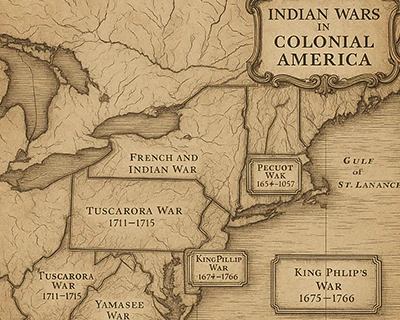
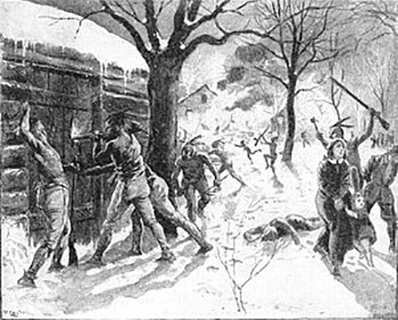
The region also carried the memory of war. King Philip’s War had brought the fighting at Bloody Brook in 1675 and Turners Falls in 1676. In February 1704, a French-led force that included Native American allies attacked Deerfield, killed inhabitants, and carried more than one hundred captives northward. Ebenezer Marsh was sixteen at the time, and the attack was part of his own lifetime even though two decades had passed before he built at Hunting Hills.
Edward Pearson Pressey, in his History of Montague, described Marsh’s cabin at Taylor Hill and set its construction against the warfare that had shaped the valley during the preceding half-century.5 By the 1720s the military situation had changed, though raids and alarms continued intermittently along the frontier.
Dorothy was too young to remember these events, but the stories of Deerfield, Bloody Brook, and Turners Falls would have been familiar to families throughout the valley.
Whether Dorothy and the rest of the Marsh household moved into Ebenezer’s cabin at once is not established. Her father’s property transactions suggest that the family kept ties to Sunderland while Hunting Hills developed. What is certain is that she grew up as her father and other settlers were turning the district into a permanent farming community. Her connection to Montague began in her childhood, in the earliest years of its settlement.
Marriage to Nathaniel Gunn
On 21 March 1745, Dorothy married Nathaniel Gunn, a son of Deacon Nathaniel Gunn and Esther Belden. Nathaniel was born in Sunderland on 24 January 1726, two and a half years younger than his wife.3
The marriage brought Dorothy into a family that traced its history to Dr. Jasper Gunn, who arrived in Massachusetts aboard the Defence in 1635 before settling in Connecticut. Nathaniel’s grandfather, Deacon Samuel Gunn, had helped establish the Gunn family in the upper Connecticut River Valley, and his father, also named Nathaniel, continued the family’s place in the religious and agricultural life of Sunderland and Montague. The two families were already linked by landownership, religion, and generations of settlement.
The couple began their family during a period of growth in the northern part of Sunderland. In 1754 the district became the separate town of Montague.
Nathaniel was known locally as Lieutenant Nathaniel Gunn, a title associated with his militia service, and as Deacon Gunn, reflecting his role in church affairs. Later family histories also describe him as an active Baptist and a tavern keeper.6
The Baptist Tavern
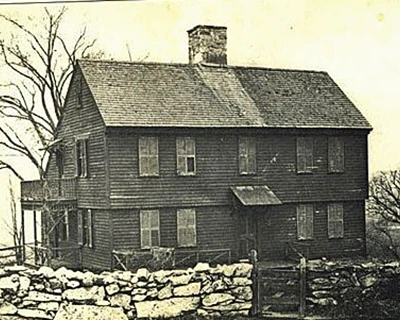
According to the Gunn family history, Nathaniel’s tavern became a gathering place for traveling Baptist ministers, and over time the house acquired the name the Baptist Tavern.6
In eighteenth-century New England, a tavern served as more than a place for food and lodging. Travelers exchanged news there, neighbors discussed local affairs, and merchants did business. Some taverns also served as informal meeting places for religious and political discussion.
Nathaniel’s welcome to Baptist ministers is significant. Massachusetts had developed under a system in which Congregational churches held a privileged position. Baptists challenged that system, especially infant baptism and the compulsory financial support of established churches, and their advocacy of religious liberty brought them into conflict with civil and religious authorities. The movement grew through the eighteenth century among people who believed that faith should rest on personal conviction rather than public obligation.
No record yet identified documents Dorothy’s own religious views, but she lived in a household closely tied to Baptist activity. Ministers and travelers who stopped at the tavern probably brought news and ideas from communities across New England.
A tavern also ran on household labor: meals to prepare, linens to wash, supplies to keep, guests to accommodate. That work commonly fell to the wives and children of tavern keepers, although Dorothy’s specific responsibilities are not documented. The Baptist Tavern nonetheless gives a glimpse of the world in which she spent much of her married life, where family, commerce, hospitality, and religious change met.
Two Sisters and Two Brothers
Dorothy’s younger sister, Thankful Marsh, created a second link between the Marsh and Gunn families. On 28 November 1751, Thankful married Asahel Gunn, Nathaniel’s younger brother, so that two Marsh sisters had married two Gunn brothers.7 Dorothy and Thankful were sisters by birth and sisters-in-law by marriage, and their children belonged to closely related branches of the Gunn family.
Both couples lived in Montague during its formative years and shared the concerns of farming families: raising children, maintaining farms, taking part in church affairs, and sustaining the relationships a small town depended on.
Thankful is remembered in local history for another reason. She has been identified as Montague’s first schoolteacher, giving instruction in reading, writing, and arithmetic to the settlement’s children.8 Early New England schools were modest undertakings, held in a private home or other available building, with children using whatever books and writing materials their families could supply. Her teaching was a contribution to the community beyond her own household, and a reminder that women helped build colonial towns in ways official histories seldom recorded.
Dorothy’s own activities outside the household remain largely undocumented. Together, the two sisters helped establish the next generations of the Gunn family in Montague.
Raising the Next Generation
Dorothy and Nathaniel raised a large family while Montague was becoming an established town. Compiled genealogical records name nine children: Dorothy, Submit, Jemima, Nathaniel, Stephen, Elijah, Elihu, Elisha, and Mercy. Their reported births run from 1745 into the late 1760s, although the complete family register has yet to be verified against original town records.9
Raising a family in eighteenth-century Massachusetts meant constant labor, with every member of a farming household contributing as the children grew. Women supervised food preparation, clothing production, household stores, and the care of younger children. They preserved food for winter, tended gardens, managed domestic resources, and often worked in the fields. In a household that also kept a tavern, the family economy depended on coordinating domestic and commercial work. For Dorothy, motherhood spanned more than two decades, with her eldest children nearing adulthood while the youngest were still being born.
Her children carried the family into different communities and different chapters of American history.
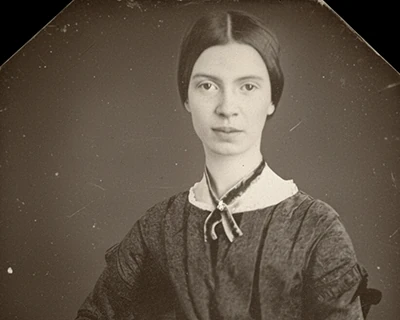
Her son Nathaniel Gunn, born in 1752, married Hannah Montague and was the father of Lucretia Gunn (1775–1840). Lucretia married Samuel Fowler Dickinson and became the paternal grandmother of the poet Emily Dickinson, which makes Dorothy Emily Dickinson’s great-great-grandmother.
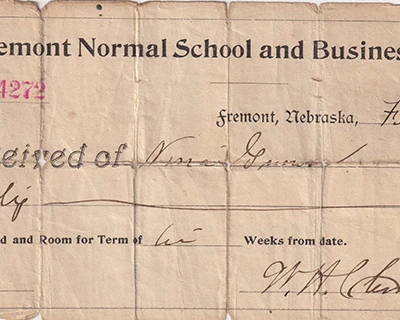
Another son, Deacon Elihu Gunn (1763–1851), married Lucy Phelps and continued the direct ancestral line followed in The Gunns in America. Through Elihu and his descendants, the family’s history extended west to Illinois and Nebraska.
The two branches show how family histories diverge. One stayed close to the cultural and intellectual life of western Massachusetts. The other joined the westward migration that transformed the United States in the nineteenth century. Both began in the household of Dorothy Marsh and Nathaniel Gunn.
From Colony to Republic
Dorothy was fifty-one when the Revolutionary War began in April 1775. Montague had been an incorporated town for more than twenty years, and its farms, roads, churches, and civic institutions were established features of the valley.
The movement toward independence would have been familiar to families throughout western Massachusetts. Disputes with Great Britain, demands for colonial rights, and the activities of local militia companies were discussed in town meetings, taverns, churches, and homes.
Nathaniel Gunn held the rank of lieutenant, and the family had a tradition of military service stretching back several generations. But the title alone does not establish when or where he served, and his Revolutionary War service remains to be documented.
The war disrupted daily life. Military demands affected farming and trade, and inflation and shortages added to the burdens on households. Dorothy’s own opinions on independence have not survived in the records identified so far, and we cannot know how the war touched her household.
We do know that she lived through the transformation. She was born a subject of the British Crown, during the reign of George I. She was a mother with a growing family when Britain and France contested North America in the French and Indian War. She saw the thirteen colonies declare independence, endured the Revolutionary War, and witnessed the creation of a new federal government. When George Washington became president in 1789, she was sixty-five, and the political world of her childhood was gone.
Women experienced that transition differently from men. Independence brought new forms of government and new ideas about political liberty, but women remained excluded from most formal political authority, and their contributions were recorded mostly through the histories of their husbands, fathers, and sons. Dorothy’s life shows both the importance of those contributions and the difficulty of recovering them from the surviving record.
The Later Years
By the end of the eighteenth century, Dorothy and Nathaniel belonged to an older generation in Montague. Their children had households of their own, and their grandchildren were growing up in a country very different from the province of Dorothy’s childhood. The community her father had helped settle had changed as well, from scattered farms in the Hunting Hills district to a town with established institutions and generations of residents.
Her sister Thankful was widowed in 1796 when Asahel Gunn died.
Dorothy died on 13 July 1805, shortly before her eighty-second birthday.2 Her husband survived her by nearly two years, dying on 22 April 1807. Their marriage had lasted about sixty years.
In 1805 the Lewis and Clark expedition, which had left the St. Louis area in May 1804, was still exploring the newly acquired Louisiana Territory. Dorothy never saw the great movement of settlers across the continent, but her descendants would become part of it.
The Continuity of Family
Dorothy Marsh Gunn left no known letters, diary, or account of her life. Her story survives mainly in family records and in the histories of the communities where she lived. Those records do not tell us what she thought about the Revolution, how she understood the religious controversies of her time, or what she hoped for her children, and they reveal little of the person behind the name.
The outlines of her life are nonetheless clear. She was born in Sunderland when the community was young. Her father helped establish the settlement at Hunting Hills, where the town of Montague emerged. She married into a family long rooted in the valley and raised her children through decades of religious, political, and social change. Her sister married her husband’s brother, joining the two families a second time. Her household became associated with the Baptist movement, and her descendants carried the Gunn name into the nineteenth century and beyond.
Through her son Nathaniel, she is an ancestor of Emily Dickinson. Through her son Elihu, she is an ancestor of the Gunn family whose journey led from Massachusetts to the prairies of Illinois and Nebraska. She lived her entire life within a small region of New England, yet the generations that followed traveled far beyond the world she knew.
Dorothy Marsh Gunn belonged to the generation that turned a colonial frontier into an enduring community, and the family she helped sustain carried its history far beyond the river valley.
Endnotes
Footnotes
-
Dwight Whitney Marsh, Marsh Genealogy: Giving Several Thousand Descendants of John Marsh of Hartford, Ct., 1636–1895 (Amherst, MA: Carpenter & Morehouse, 1895); see also Alice Lucinda Priest, “Gilletts’ Descendants,” The American Genealogist, as referenced in the compiled Holcombe genealogy. Published genealogies generally give Dorothy’s birth as 28 July 1723, rather than 26 July. The date of 26 July follows the family information provided for this biography and awaits verification in the original Sunderland records. ↩ ↩2
-
Dorothy Marsh family record; Holcombe Genealogy. Both report her death on 13 July 1805. Although modern genealogies often place her death in Franklin County, Montague was in Hampshire County until Franklin County was created in 1811. ↩ ↩2
-
“Dorothy Marsh Family Group,” FamousKin; “Nathaniel Gunn and Dorothy Marsh Family,” Our Family History. These compilations give 21 March 1745 for the marriage. Some sources give 1747, and others record the date in old-style notation as 1744/45. Original marriage records are needed for final confirmation. ↩ ↩2
-
Edward Pearson Pressey, History of Montague: A Typical Puritan Town (Montague, MA, 1910), Book II, 15–16. Pressey identifies Ebenezer Marsh’s cabin at the southern foot of Taylor Hill as an important beginning of the settlement at Hunting Hills. Digitized edition. ↩
-
Pressey, History of Montague, Book II, 15–16. His account places the settlement within the historical memory of Bloody Brook, Turners Falls, and the 1704 attack on Deerfield. His language concerning Indigenous peoples reflects the perspective of an early twentieth-century local historian and should be read in that context. ↩
-
The Gunns, 69, a compiled Gunn family history available in a digitized edition. The account identifies Nathaniel as a lieutenant and deacon and describes his tavern as a gathering place for traveling Baptist ministers. It is useful family-history evidence, but its description of the tavern has not yet been independently corroborated by contemporary records. ↩ ↩2
-
The Gunns, 69. The history identifies Asahel Gunn as Nathaniel’s brother and Thankful Marsh as Asahel’s wife, married in 1751. It gives Asahel’s birth as 16 November 1736, which conflicts with the 1730 birth year used in some family genealogies. The relationship is established in the compiled history, but Asahel’s birth year requires further investigation. ↩
-
Pressey, History of Montague, section on the town’s early schools; The Gunns, 69. Both preserve the tradition that Thankful Marsh Gunn taught an early school in Montague. The claim that she was the first schoolteacher should be treated as a historical tradition until supported by contemporary educational or town records. ↩
-
“Nathaniel Gunn and Dorothy Marsh Family,” Our Family History. The compilation identifies nine children. Their dates and identities should be checked individually against town vital records. The birth of Elihu Gunn, in particular, requires reconciliation among the family sources. ↩