Elijah Gunn Sr. — Pioneer of the Western Reserve
Pioneer of the Western Reserve and Maumee Valley
Elijah Gunn Sr. (1759–1855)
Pioneer of the Western Reserve and Maumee Valley
Elijah Gunn Sr. lived nearly a century, long enough to witness the transformation of thirteen British colonies into a continental republic. Born in Massachusetts before the American Revolution, he carried the memory of that struggle westward, becoming one of the earliest European-American settlers of Ohio’s Western Reserve and a pioneer of the region that would become Cleveland.
His life followed the expanding frontier of the early United States: from Revolutionary Massachusetts to the shores of Lake Erie, from the first cabins along the Cuyahoga River to the settlements of the Maumee Valley. In each place, he belonged to a generation that transformed the landscape through migration, labor, and the establishment of new communities.
Although Elijah was not a direct ancestor in the principal lineage of The Gunns in America, his story illustrates an important pattern in the family’s history. The Gunns did not remain confined to the towns and farms of colonial New England. As opportunities and circumstances changed, successive generations carried their households westward, often entering communities still in the process of formation.
Elijah Gunn was among those who went first.
A Childhood in Revolutionary Massachusetts
According to his obituary, published in The North-West on 28 September 1855, Elijah Gunn was born near Boston on Christmas Day, 25 December 1759. He grew up during a period of mounting conflict between Great Britain and its American colonies.
The Boston Massacre of 5 March 1770 occurred when Elijah was ten years old. Five civilians died following a confrontation with British soldiers, and the event became an enduring symbol of colonial resistance.
Elijah’s obituary records that he attended an anniversary commemoration of the massacre and heard Dr. Joseph Warren deliver an oration at Boston’s Old South Church. Warren, a physician and prominent Patriot leader, would later die at the Battle of Bunker Hill in June 1775.
The memory remained vivid throughout Elijah’s life. His obituary writer recalled how, when Elijah repeated passages from Warren’s speech, his emotions rose as though the events had occurred only yesterday. Even in extreme old age, his eyes reportedly brightened with the spirit of the Revolution.
For Elijah, the Revolution was not merely a chapter in a history book. It was a collection of remembered voices, places, and experiences that helped shape his understanding of citizenship.
Later accounts identify him as a Revolutionary War soldier. His name appears in the Ohio Daughters of the American Revolution’s roster of Revolutionary soldiers buried in the state. However, the available accounts do not establish his regiment, dates of service, or military assignments. Until those details are independently documented, his military service should be treated as a reported tradition rather than a fully verified fact.
The Western Reserve: A New Beginning
Following American independence, the westward movement of settlers accelerated. Among the territories attracting attention was the Connecticut Western Reserve, a large tract in northeastern Ohio claimed and subsequently sold by Connecticut.
In 1795, the Connecticut Land Company acquired most of the Reserve and organized an expedition to survey its lands, establish townships, and prepare for settlement. The following spring, a party under the direction of Moses Cleaveland traveled west toward Lake Erie.
Elijah Gunn and his wife, Anna Sartwell Gunn, accompanied the expedition.
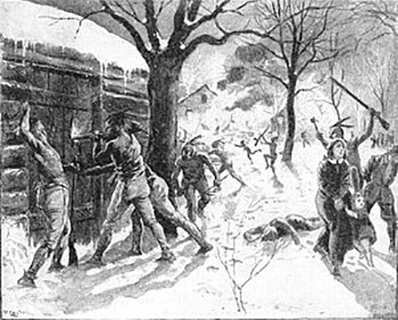
On 4 July 1796, the party reached the mouth of Conneaut Creek, near the Pennsylvania boundary. The date was the twentieth anniversary of American independence, a coincidence not lost on those who later recorded the expedition.
An early history of Cleveland listed fifty-two persons in the party, including Elijah, his wife, and a child. Only two adult women were present: Anna Gunn and Talitha Cumi Stiles, wife of Job Phelps Stiles.
The presence of these families distinguished the expedition from a purely military or surveying operation. They had undertaken the journey with the possibility of making permanent homes in a region unfamiliar to most New Englanders.
For Anna Gunn, the undertaking required particular courage. The journey involved difficult transportation, uncertain shelter, limited provisions, and the challenges of caring for a child far from established communities.
The Western Reserve was not an uninhabited wilderness. Indigenous peoples had occupied, traveled, hunted, and maintained relationships with the region for generations. Connecticut’s land claims and the activities of the land company were part of the larger process through which Indigenous territories passed into American control. The settlement that Elijah and Anna helped establish must be understood within that broader history.
The Winter at Conneaut, 1796–1797
When the surveyors prepared to return east in the autumn of 1796, Elijah and Anna remained at Conneaut.
They were entrusted with the company’s supply depot, known as Stow’s Castle, a rough log structure built near the creek. Their own cabin stood approximately a mile farther upstream, according to historian Charles Whittlesey.
The winter of 1796–1797 was among the earliest winters spent by families associated with the Connecticut Land Company’s settlement efforts.
The Gunn household faced the uncertainties common to frontier life: isolation, difficult travel, shortages of familiar supplies, and dependence upon the surrounding environment. Although the details of their daily experience have not survived, Whittlesey later observed that Elijah and Anna appeared to have endured the hardships better than many of their contemporaries.
Their presence at Conneaut was an important part of the settlement process. Surveying parties could establish boundaries and draw maps, but permanent occupation required families willing to remain when the surveyors departed.
Elijah and Anna Gunn were among those families.
Among Cleveland’s Earliest Settlers
In May 1797, Elijah and Anna left Conneaut and moved west to the mouth of the Cuyahoga River, where the Connecticut Land Company had laid out the settlement that would become Cleveland.
They initially occupied a company cabin near the river and subsequently built a dwelling on River Street. The low-lying settlement presented serious health problems, including mosquito-borne disease. Like several other early families, the Gunns eventually moved to higher ground in the Newburgh area, where they established a farm.
The distinction between the first surveyors and the first permanent settlers is important. Job and Talitha Stiles had remained at Cleveland during the winter of 1796–1797 and are generally recognized as the settlement’s first resident family. Elijah and Anna, meanwhile, had spent that winter at Conneaut.
Nevertheless, the Gunns belonged to the earliest group of families whose continued residence gave substance to the new settlement.
A later history, The Pioneer Families of Cleveland, identifies Anna as Anna Sartwell Gunn and records the family’s movement from Conneaut to Cleveland and then to the higher ground beyond the river.
Anna’s contribution received tangible recognition. In 1803, the Connecticut Land Company approved a grant of one hundred acres to her. The grant was an acknowledgment of her place among the earliest women settlers of the Western Reserve.
It is a remarkable detail. In an era when women’s contributions were frequently overlooked in public records, Anna’s presence and service were recognized in the distribution of land.
The family also participated in the ordinary work of building a community. Elijah appears in later accounts as a man who accepted modest civic responsibilities, while his household became part of the growing network of farms, trades, and families surrounding Cleveland.
A Fourth of July Celebration
Among the memories Elijah preserved was an Independence Day gathering held at the cabin of Major Lorenzo Carter on 4 July 1801.
Carter was another prominent early settler, remembered for his influence in Cleveland’s formative years.
Elijah told his obituary writer that he attended what he remembered as the first ball held in Cleveland.
The scene offers a rare glimpse of social life in a settlement still little more than a collection of cabins and clearings. Neighbors gathered to celebrate the anniversary of independence, renewing familiar customs in a place far removed from the established towns of New England.
For Elijah, who had grown up amid the events preceding the Revolution, the occasion must have carried particular significance.
A quarter century earlier, the Declaration of Independence had announced the creation of a new nation. Now, on its anniversary, families were gathering beside the Cuyahoga River in a settlement that would eventually become one of America’s great industrial cities.
The celebration represented something more than recreation. It was an expression of community, an affirmation that the settlers intended to remain and establish a recognizable civic life.
Westward Again: The Maumee Valley
Elijah’s movement west did not end with Cleveland.
Following the War of 1812, he and members of his family became associated with the Maumee Valley in northwestern Ohio.
His tombstone identifies him as a pioneer of Ohio in July 1796 and of the Maumee Valley in 1815. His obituary describes a move from Cleveland to Waterville and subsequently to Girty’s Point along the Maumee River.
A later account identifies him as a pioneer at Girty’s Point in 1826, opposite the eastern end of an island in what became Flat Rock Township.
These dates may refer to different stages of his movement and settlement. The evidence establishes his association with the Maumee Valley but does not yet provide a complete chronology of his residences.
The Maumee Valley was itself undergoing profound changes. The War of 1812 had brought military campaigns and conflict involving American, British, and Indigenous forces. In the decades that followed, increasing numbers of settlers entered the region, establishing farms, roads, mills, and communities.
For Elijah, the move represented another encounter with the expanding frontier. The lands surrounding Cleveland had been sparsely settled when he arrived in 1797. Now, decades later, he was moving into another region undergoing the same process of transformation.
He was no longer a young pioneer. By 1815, he was approximately fifty-five years old.
Yet the impulse to move, establish a household, and participate in the development of a new community remained part of his life.
Three Generations of Service
Elijah’s family history also preserves an association with military service across three generations.
Elijah Sr. was identified in later genealogical records as a soldier of the American Revolution. His son, Elijah Gunn Jr., served during the War of 1812. His grandson Cyrus Gunn was associated with the Grand Army of the Republic, the organization established for Union veterans of the Civil War.
All three were reportedly buried in the Gunn cemetery.
A note accompanying Elijah Sr.’s entry in the Ohio Revolutionary soldiers’ roster warns that a Grand Army of the Republic Post 66 marker had been incorrectly associated with the elder Elijah’s grave. The marker properly belonged to his grandson Cyrus.
The distinction matters. Memorial markers, especially those added decades after a person’s death, can introduce errors into the historical record. They must be evaluated alongside contemporary records and the identities of other family members.
The presence of three generations in the same burial ground nevertheless offers a compelling picture of family continuity.
Their lives spanned the Revolution, the War of 1812, and the Civil War, three conflicts that helped define the American republic during its first century.
The Last Years
By the early 1850s, Elijah Gunn had become one of the few surviving witnesses to the events of Revolutionary Massachusetts and the first settlement of the Western Reserve.
His obituary describes a man of strong character, industrious habits, and considerable knowledge of American history. Until his final years, he remained engaged with public affairs.
He reportedly walked three miles to the community of Florida, Ohio, and returned unaided. He also maintained a lifelong commitment to voting, rarely, if ever, missing an election.
The obituary associated him with the maxim:
“Eternal vigilance is the price of liberty.”
The sentiment reflected the civic outlook of a man whose earliest political memories reached back to the struggle for independence.
Only during the final two years of his life did declining sight and hearing seriously limit his ability to converse with others.
Yet his memories survived in the recollections of neighbors and descendants.
A later account by Mamie Hunt Cassety preserved the testimony of R. W. Hartman of Napoleon, Ohio, who recalled personally knowing Elijah and attending his funeral. Hartman, then eighty-eight years old, remembered details of the occasion.
This recollection offers a final connection between the early republic and the generations that followed. Long after Elijah’s death, people who had known him continued to preserve his story.
Death and Remembrance
Elijah Gunn Sr. died on the morning of 22 September 1855, at the residence of his son in Flat Rock Township, Henry County, Ohio.
His obituary appeared six days later in The North-West, under the heading “Another Revolutionary Patriot Gone.”
The writer reflected upon the extraordinary changes Elijah had witnessed. When he was born, the American colonies contained approximately three million inhabitants and remained subject to the British Crown. By his death, the United States had grown to a nation of more than twenty-five million people.
He had witnessed the Revolution, the establishment of the Constitution, the War of 1812, and the expansion of American settlement across much of the continent.
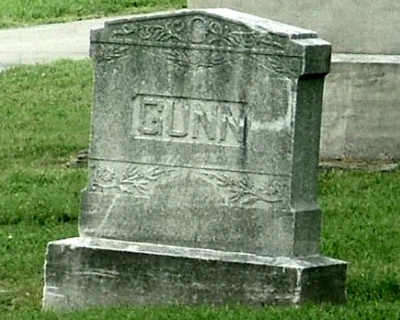
His tombstone preserves a concise account of his pioneering life:
“A pioneer of Ohio July 1796 and of the Maumee Valley 1815.”
The inscription gives his age at death as ninety-five years, eight months, and eight days. That age implies a birth date of 14 January 1760, differing from the Christmas Day 1759 date reported in his obituary. Both dates remain part of the documentary record pending stronger evidence.
His burial in the Gunn cemetery, alongside descendants whose lives belonged to succeeding generations, marks the end of a remarkable personal journey.
Elijah Gunn and the Family Tradition
Elijah Gunn’s life is particularly meaningful within the broader history of the Gunn family because it demonstrates that westward migration was neither an isolated event nor the experience of a single ancestral line.
The movement that carried Jasper Gunn from England to Massachusetts and Connecticut in the seventeenth century found later expressions in the migration of descendants and collateral relatives across the American interior.
Elijah belonged to the generation that carried New England settlement into northeastern Ohio. Other Gunn families would follow different routes into western New York, Pennsylvania, Ohio, Illinois, and eventually the Great Plains.
The circumstances varied. Some moved in search of farmland, others followed employment, commercial opportunities, or relatives who had already established themselves in new communities.
The larger pattern was one of movement, adaptation, and the effort to establish continuity in unfamiliar places.
Elijah’s experience also reminds us that the westward expansion of the United States was neither simple nor without consequence. The establishment of new American settlements transformed Indigenous homelands and altered the lives of communities already present.
A responsible family history must recognize both the perseverance of its ancestors and the wider historical circumstances in which they lived.
Elijah Gunn was not a famous statesman, military commander, or industrial pioneer. His distinction rests instead upon the ordinary but consequential work of settlement.
He crossed into the Western Reserve with his wife and child, remained through an uncertain winter, helped establish a household near the future city of Cleveland, and continued westward into the Maumee Valley.
He lived long enough to see the frontier of his younger years become the settled communities of another generation.
His story belongs in The Gunns in America not because he stands in its direct ancestral line, but because his life illuminates the broader experience of the family.
The Gunn name is the spine, not the skin.
Elijah represents one of the branches extending outward from that spine, carrying the family’s history into another region and another generation.
The river of migration did not follow a single course. It divided, turned, and found new channels.
Elijah Gunn was among those who carried it west.
Historical Notes and Sources
- Obituary of Elijah Gunn Sr. “Another Revolutionary Patriot Gone,” The North-West, 28 September 1855. The obituary supplies his reported birth date, Revolutionary memories, arrival at Conneaut, recollection of the 1801 celebration, later migration, character, and death. The text used here is a supplied transcription; the original newspaper image has not been independently examined.
- Charles Whittlesey, Early History of Cleveland, Ohio (1867). The chapters on the 1796 survey and early pioneers identify Elijah and Anna Gunn among the families accompanying the expedition, describe their responsibility for Stow’s Castle, and preserve details of their early residence. Available through Cleveland State University’s digital edition.
- Gertrude Van Rensselaer Wickham, The Pioneer Families of Cleveland, 1796–1840, vol. 1 (1914). The account of the earliest families identifies Anna Sartwell Gunn, describes the family’s movements from Conneaut to Cleveland and Newburgh, and discusses their early settlement experience.
- James Harrison Kennedy, A History of the City of Cleveland: Its Settlement, Rise and Progress, 1796–1896 (1896). Provides context for the Connecticut Land Company’s expedition and confirms that Elijah and Anna remained at Conneaut while the Stiles family stayed at Cleveland.
- Ohio Society, Daughters of the American Revolution, The Official Roster of the Soldiers of the American Revolution Buried in the State of Ohio. Entry for Elijah Gunn Sr., preserving his tombstone inscription, association with Girty’s Point, military-service traditions, and the correction concerning the Grand Army of the Republic marker. Publication details and original page should be checked against the printed edition.
- Lewis Cass Aldrich, History of Henry and Fulton Counties, Ohio (1888), p. 670. Cited by the later Revolutionary soldiers’ roster as a source concerning Elijah Gunn. The relevant page requires direct examination before attributing specific statements to Aldrich.
- Ohio historical accounts of pioneer women and land grants. Records of Connecticut Land Company grants identify a one-hundred-acre allotment to Anna Gunn, recognizing her place among the early settlers.
Research Questions
The principal unresolved questions concern Elijah’s exact birth date and parents, the documentary basis for his Revolutionary War service, the complete list of his children, the date and circumstances of Anna Sartwell Gunn’s death, and the chronology of his moves through Waterville and Girty’s Point.
Land deeds, probate records, military service records, and original cemetery documentation may resolve several of these questions.
Editorial note: This biography combines contemporary testimony, nineteenth-century local histories, and later genealogical compilations. Statements concerning Revolutionary service and some family relationships remain provisional until supported by primary records.