






John Gunn (1707–1793)
Deacon, Town Leader, and Revolutionary-Era Citizen
John Gunn (1707–1793)
Deacon, Town Leader, and Revolutionary-Era Citizen
John Gunn was born on 3 December 1707 at Hatfield, Massachusetts, the ninth known child of Deacon Samuel Gunn and Elizabeth Wyatt.[1] He belonged to a generation of the Gunn family that no longer faced the problem of establishing itself in New England. Instead, John inherited something different: the responsibility of maintaining the communities his parents and grandparents had helped create.
Over the course of a life spanning nearly eighty-six years, he became deeply involved in both church and town government. He served as a town clerk, selectman, representative in the Massachusetts legislature, deacon of the Congregational church, and, during the American Revolution, a member of Montague’s Committee of Correspondence.[2]
His public record gives unusual substance to a man who might otherwise appear in a genealogy simply as another name between generations. John Gunn was one of the men upon whom eighteenth-century New England towns depended.
Parents and Family Background
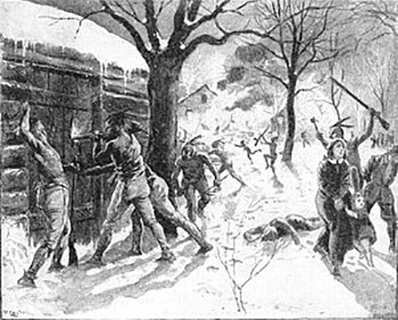
John’s father, Deacon Samuel Gunn (1662–1755), was the son of Nathaniel Gunn and Sarah Day and the grandson of Jasper Gunn, the English immigrant who arrived aboard the Defence in 1635. Samuel’s childhood had been marked by the violence of the colonial frontier. His mother Sarah and younger brother Joseph were killed during the attack on Hatfield in September 1677.
Samuel survived, married Elizabeth Wyatt in Hatfield on 22 January 1684/85, and eventually became a prominent member of the Connecticut River Valley community.[3]
John was therefore born into a family in which church service and community responsibility were already established traditions. The title “Deacon,” eventually borne by John himself, had also been carried by his father.
Elizabeth Wyatt was the daughter of John Wyatt and Mary Bronson. Her family name may explain why John is sometimes identified in later genealogical material as John “Wyatt” Gunn. At present, however, no contemporary record located in this research demonstrates that John himself used Wyatt either as a middle name or as a nickname. In eighteenth-century records he appears simply as John Gunn.
From Hatfield to Sunderland
Although some later genealogies give Sunderland as John’s birthplace, the Gunn family was still associated with Hatfield when he was born, and the surviving family record places his birth there on 3 December 1707.[4]
John subsequently became closely identified with Sunderland, where his father had settled and where John established his own household.
Little direct evidence survives concerning his education. No evidence has been found that he attended a college or received formal professional training. His later offices nevertheless demonstrate functional literacy and considerable competence with written records. A town clerk was responsible for maintaining official proceedings and vital and municipal records; such a position required dependable literacy, numeracy, organization, and the confidence of one’s neighbors.
John’s education was therefore probably of the local New England variety—schooling sufficient to prepare a capable young man for property ownership, church membership, business, and public affairs. Anything more specific should remain an open research question.
Marriage to Hannah Root
On 10 June 1736, John Gunn married Hannah Root at Sunderland.[5]
Hannah had been born there on 2 March 1718, the daughter of Joseph Root and Mary Russell. The marriage joined two established Connecticut River Valley families. The Root family had deep connections to Northampton, Hatfield, and Sunderland and, like the Gunns, participated extensively in the civic and religious life of the region.[6]
John was twenty-eight and Hannah eighteen when they married.
Their marriage lasted nearly fifty-seven years.
The Children of John and Hannah Gunn
The Sunderland records identify a large family born to John and Hannah. The surviving evidence indicates at least twelve recorded births, including a stillborn daughter and a second daughter named Editha after the death of an earlier child.[7]
Their children were:
Hannah Gunn, born 14 April 1737. She married Nathaniel Sartwell/Sutwell on 4 August 1757.
John Gunn, born 6 December 1739. He married Jerusha Oak on 1 October 1767.
Israel Gunn, born 10 May 1742. He married Mary Root, daughter of Captain Joseph Root. Israel followed his father into both church and town leadership and became Deacon Israel Gunn.
Mary Gunn, born 17 March 1745.
Elijah Gunn, born 15 October 1747.
Samuel Gunn, born 12 April 1750; he died before 1 July 1788. He married Hannah Bardwell in 1781.
Editha Gunn, born in 1753 and died in childhood, before the birth of the second Editha.
Levi Gunn, born 28/29 April 1757.
Lucy Gunn, born 29 April 1757. She later married Asahel Gunn.
An unnamed daughter, born stillborn on 29 April 1757.
The births of Levi, Lucy, and the unnamed daughter were recorded together and appear to represent the birth of triplets—a particularly remarkable event in eighteenth-century New England.[8]
Salmon Gunn, born 20 June 1760.
Editha Gunn, born 27 December 1762, apparently named for the older sister who had died.
The children’s birth records reveal something easily missed in a simple family tree: John and Hannah were raising children for approximately twenty-five years, from 1737 until 1762. Their youngest child was born when John was fifty-five and Hannah forty-four.
Occupation and Economic Life
No surviving evidence located so far identifies John with a specialized trade such as medicine, law, or the ministry.
He should therefore be described cautiously as a farmer and landholder, as were most men of his standing in eighteenth-century Sunderland and Montague, while recognizing that a significant part of his documented working life was devoted to public administration and community leadership.
The Sunderland history places John Gunn among proprietors participating in divisions of town lands. Landholding was more than an economic matter in colonial Massachusetts: it was closely tied to voting, taxation, family inheritance, and standing within the community.[9]
John’s public offices make it clear that farming alone does not adequately describe his life.
Town Clerk and Selectman
A nineteenth-century genealogy of the Root family, drawing upon earlier Sunderland records, describes John as town clerk, a deacon in the Congregational church, and a “prominent citizen” of Sunderland.[10]
Independent evidence confirms his participation in town government.
In December 1748, John Gunn appears as one of Sunderland’s selectmen, together with Samuel Smith and Jonathan Field. The selectmen petitioned concerning Samuel Billings, a local blacksmith who had become incapable of managing his own affairs, requesting that an appropriate guardian be appointed.[11]
That record is especially valuable because it moves John beyond genealogical tradition and places him directly within the machinery of eighteenth-century local government.
A selectman was among the principal executive officers of a New England town. Selectmen supervised local finances, property, roads, poor relief, legal obligations, and other matters affecting the community.
John was not simply living in Sunderland. He was helping govern it.
Representative to the Massachusetts General Court
John’s civic career extended beyond town government.
Records of the Massachusetts House of Representatives identify a John Gunn of Sunderland who had been allowed a seat in the House and later petitioned concerning compensation for fifty-seven days of travel and attendance during the November and winter sessions.[12]
The geographical identification and period strongly indicate Deacon John Gunn.
This means John served as Sunderland’s representative in the colonial legislature—the Massachusetts General Court—placing him among the relatively small number of local men entrusted to represent their communities at the provincial level.
His service is important for understanding his social position. The offices of clerk, selectman, deacon, and representative were not isolated honors. Together they describe a sustained career of public trust.
Deacon of the Church
John was also elected deacon of the Congregational church.[13]
In eighteenth-century Massachusetts, the office carried substantial responsibility. Deacons assisted in the practical administration of the congregation, participated in care for members in need, and occupied a visible position within the religious community.
The office also continued a striking Gunn family pattern.
John’s father Samuel had been a deacon. John’s brother Nathaniel became a deacon. John himself became a deacon, and John’s son Israel later appears in Montague records as Deacon Israel Gunn.
Church leadership was becoming an intergenerational feature of this branch of the family.
Removal to Montague
In 1761, John and Hannah removed from Sunderland to Montague, a newer community just to the north.[14]
John was then about fifty-three years old. Rather than withdrawing from public affairs, he almost immediately became part of Montague’s leadership.
The town’s surviving list of selectmen records:
Deacon John Gunn — 1762, 1766, and 1777.[15]
The dates are revealing. His final recorded term as selectman came during the American Revolution, when John was approaching seventy.
His son Israel subsequently became one of Montague’s most frequently elected selectmen, serving repeatedly from 1778 into the opening years of the nineteenth century. Civic leadership had passed from father to son.
John Gunn and the American Revolution
John was sixty-seven when fighting broke out at Lexington and Concord in April 1775.
No reliable evidence has yet been located showing that he served personally as a soldier during the Revolution. His age makes regular field service unlikely, and he should not presently be identified as a Revolutionary War soldier.
His Revolutionary service was instead civil and political—and it is documented.
On 10 March 1777, Montague elected a three-man Committee of Correspondence consisting of:
Deacon John Gunn, Dr. Moses Gunn, and Sergeant Nathaniel Smith.[16]
Committees of correspondence formed part of the political infrastructure of the Revolution. They communicated information among towns and revolutionary authorities, helped maintain political coordination, and supported the local administration of the Patriot cause.
Montague separately appointed a Committee of Inspection and Safety, demonstrating that John’s Committee of Correspondence was a distinct civic assignment rather than military service.[17]
The distinction is important.
John Gunn did not need to carry a musket to participate in the Revolution. At nearly seventy, he served in precisely the sphere in which he had accumulated decades of experience: local government, communication, and community trust.
His Revolutionary record should therefore be listed as:
Military service: No documented military service located.
Patriotic/civil service: Member, Montague Committee of Correspondence, 1777; selectman of Montague during the Revolutionary era.
The Gunn Family at War
The broader family was considerably more involved militarily.
The history of Montague records Gunn men among those responding to the Lexington alarm in April 1775, including Asahel Gunn and Samuel Gunn, while other Gunn relatives held military and public positions during the war.[18]
John therefore occupied an interesting generational position. He belonged to the older colonial leadership while younger members of the extended family entered military service.
He had been born a subject of Queen Anne.
He lived through the reigns of George I, George II, and George III.
He died a citizen of the United States.
Hannah’s Death and John’s Final Year
Hannah Root Gunn died on 9 March 1793, aged seventy-five. The Montague vital record specifically identifies her as the wife of Deacon John Gunn.[19]
John survived her by only seven months.
He died on 8 October 1793, aged eighty-five. Evidence points to Montague, rather than Hatfield, as his place of death, and genealogical sources identify his burial with Montague’s Old South Cemetery.[20]
Thus John and Hannah’s marriage, begun in Sunderland in 1736, endured through the French and Indian wars, the political crisis with Britain, the Revolution, independence, the Confederation period, ratification of the Constitution, and the beginning of George Washington’s second presidential term.
Position in the Community
Taken individually, none of John Gunn’s offices would necessarily make him exceptional. Taken together, they present a much clearer portrait.
He was a:
- Landholder and farmer
- Town clerk
- Selectman in Sunderland
- Representative to the Massachusetts General Court
- Congregational deacon
- Selectman of Montague in 1762, 1766, and 1777
- Member of Montague’s Committee of Correspondence during the Revolution
This was a substantial public career.
John belonged to the class of local New England leaders who operated below the level of famous governors, generals, and revolutionary statesmen but upon whom colonial government depended. Town records had to be maintained. Taxes had to be assessed. Roads and property disputes had to be managed. Churches required administration. Representatives had to be sent to the General Court. During revolution, committees had to coordinate the political work of independence.
John Gunn repeatedly appears among the men chosen to perform those tasks.
Legacy
John Gunn’s life illustrates an important transition within the early Gunn family.
His great-grandfather Jasper Gunn belonged to the immigrant generation that crossed the Atlantic and helped establish new communities. His father Samuel Gunn survived the violence and insecurity of the seventeenth-century frontier. John inherited a more settled world—but maintaining that world required its own kind of work.
His contribution was institutional.
He kept records. He administered town affairs. He represented his neighbors. He served his church. When revolution came, he participated in the political machinery that sustained it.
And the pattern continued. His son Israel Gunn became a deacon and long-serving Montague selectman, carrying the family’s civic tradition into another generation.
John Gunn therefore occupies an important place in the Gunn story not because of a single dramatic event, but because of the accumulated evidence of a lifetime of public trust.
He represents the moment when a family established in New England became deeply embedded in the institutions of its communities.
Timeline
1707 — December 3
Born at Hatfield, Massachusetts, son of Samuel Gunn and Elizabeth Wyatt.
1736 — June 10
Married Hannah Root at Sunderland.
1737
Birth of daughter Hannah.
1739
Birth of son John.
1742
Birth of son Israel.
1745
Birth of daughter Mary.
1747
Birth of son Elijah.
1748
Documented serving as one of Sunderland’s selectmen.
1750
Birth of son Samuel.
1753
Birth of daughter Editha.
1757 — April 29
Birth of Levi, Lucy, and an unnamed stillborn daughter, apparently triplets.
1758 era
Documented in Massachusetts legislative records as having served in the House of Representatives for Sunderland.
1760
Birth of son Salmon.
1761
Removed from Sunderland to Montague.
1762
Served as Montague selectman; birth of second daughter named Editha.
1766
Again served as Montague selectman.
1777 — March 10
Chosen to Montague’s Committee of Correspondence with Dr. Moses Gunn and Sergeant Nathaniel Smith.
1777
Served another term as Montague selectman.
1793 — March 9
Hannah Root Gunn died at Montague.
1793 — October 8
John Gunn died, aged eighty-five.
Family
Father: Deacon Samuel Gunn (1662–1755)
Mother: Elizabeth Wyatt (c. 1665–1737)
Wife: Hannah Root (1718–1793), daughter of Joseph Root and Mary Russell; married 10 June 1736.
Children: Hannah, John, Israel, Mary, Elijah, Samuel, Editha, Levi, Lucy, an unnamed stillborn daughter, Salmon, and a second Editha.
Related Articles
- Deacon Samuel Gunn (1662–1755): From Hatfield to Sunderland
- Deacon Nathaniel Gunn (1693–1779)
- The Gunn Family and the Connecticut River Valley
- The Gunns in the American Revolution
- Sunderland: A Family Takes Root
- Montague and the Fourth Generation
- Jasper Gunn (1607–1671): The Immigrant Ancestor
Research Notes
Was his name John “Wyatt” Gunn?
The middle or nickname Wyatt should presently be considered unproved. John was the son of Elizabeth Wyatt, which provides an obvious source for the name in later genealogies, but contemporary records located thus far identify him simply as John Gunn. Until a primary source containing “John Wyatt Gunn” is found, the website should use John Gunn as the principal name.
Birthplace
Some derivative genealogies identify Sunderland as John’s birthplace. The family was associated with Hatfield at the time, and records of Samuel and Elizabeth Gunn’s children place John in the Hatfield family sequence. Hatfield is therefore the stronger identification.
Education
No evidence of college attendance or specialized schooling has been located. John’s work as town clerk and legislator establishes that he was literate and capable of conducting public business, but the nature and extent of his formal education remain unknown.
Occupation
John was almost certainly engaged in agriculture and owned land, but “farmer” should not obscure the extent of his public work. His documented civic career included town clerk, selectman, legislator, deacon, and revolutionary committee member.
Military Service
No documented military service has yet been identified for John Gunn. His Revolutionary contribution was civic rather than military. In 1777 he served on Montague’s Committee of Correspondence while also serving as selectman.
Sources & Further Reading
-
Hatfield, Massachusetts, town vital records, entry for John Gunn, son of Samuel and Elizabeth Gunn, 3 December 1707.
-
James Pierce Root, Root Genealogical Records, 1600–1870: Comprising the General History of the Root and Roots Families in America (New York: R. C. Root, Anthony & Co., 1870), 115, 128.
-
Hatfield town records, marriage of Samuel Gunn and Elizabeth Wyatt, 22 January 1684/85.
-
Hatfield and Sunderland vital records; John Montague Smith et al., History of the Town of Sunderland, Massachusetts, 1673–1899 (Greenfield, Mass.: E. A. Hall & Co., 1899).
-
Sunderland town records, marriage of John Gunn and Hannah Root, 10 June 1736.
-
Root, Root Genealogical Records, 115, 128.
-
Sunderland, Massachusetts, Births, Marriages, Deaths, 1686–1858, Gunn family entries.
-
Sunderland town records, birth entries of Levi Gunn, Lucy Gunn, and unnamed daughter, April 1757.
-
Smith et al., History of the Town of Sunderland, records of divisions among town proprietors.
-
Root, Root Genealogical Records, 128.
-
Sunderland selectmen’s petition concerning Samuel Billings, 9 December 1748; cited in Smith et al., History of the Town of Sunderland.
-
Massachusetts General Court, Journals of the House of Representatives, petition of John Gunn of Sunderland concerning compensation for fifty-seven days’ travel and attendance.
-
Root, Root Genealogical Records, 128.
-
Ibid.
-
Edward Pearson Pressey, History of Montague: A Typical Puritan Town (Montague, Mass., 1910), appendix, “Selectmen of Montague, 1756–1910.”
-
Pressey, History of Montague, 129.
-
Ibid.
-
Ibid., 127–29.
-
Vital Records of Montague, Massachusetts, to the End of the Year 1849 (Salem, Mass.: Essex Institute, 1934), 136.
-
Montague vital and cemetery records; Pressey, History of Montague.