Dr. Luther Gunn
Physician of Pittsfield, Son of the Revolutionary Generation, and Great-Uncle of Emily Dickinson
Dr. Luther Gunn lived only into his twenties or early thirties, yet his short life occupies an unusually important place in the history of the Gunn family. He was born into the generation immediately following the American Revolution, became a physician in Pittsfield, Massachusetts, married into the Dickinson family, and died of fever while the War of 1812 transformed Pittsfield into a military cantonment and major prisoner-of-war center.
His descendants carried his name westward. His sister carried Gunn blood into the Dickinson family of Amherst.
Through those two branches, the young physician who died in 1814 became both the grandfather of Amos Dewey Gunn and the maternal great-uncle of Emily Dickinson.
His story is therefore one of the places where several currents of The Gunns in America meet: Revolution, medicine, war, migration, education, literature, and the persistence of family memory.
Son of the Revolutionary Generation
Luther was a son of Captain Nathaniel Gunn and Hannah Montague Gunn of Montague, Massachusetts. Nathaniel belonged to the Revolutionary generation, placing Luther among the children who inherited the republic their fathers had fought to establish.
Luther’s exact year of birth remains unresolved. A later biographical account of his son, Luther Dickinson Gunn, states that the elder Luther was born at Montague in September 1782. The First Church of Pittsfield death record, however, recorded Dr. Luther Gunn as twenty-six years old when he died in 1814, which would place his birth around 1787 or 1788.^1 Until a contemporary birth or baptismal record resolves the discrepancy, the evidence should remain open rather than forcing a precision the records do not support.
What is considerably clearer is his place within the Gunn family. Among his siblings was Lucretia Gunn (1775–1840), whose marriage would give the Gunn family an extraordinary connection to American literary history.
Brother of Lucretia Gunn Dickinson
In 1802, Lucretia Gunn married Samuel Fowler Dickinson (1775–1838) of Amherst. Samuel Fowler became a lawyer, civic leader, state legislator, advocate for education, a founder of Amherst Academy, and one of the principal forces behind the establishment of Amherst College.^2
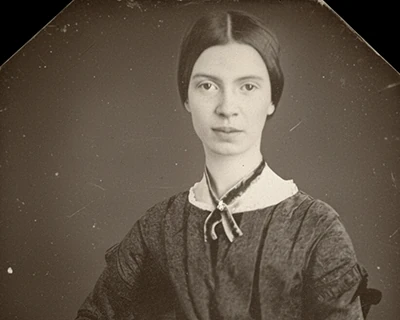
Their eldest son, Edward Dickinson (1803–1874), married Emily Norcross. Their daughter was Emily Elizabeth Dickinson (1830–1886).^3
The relationship is therefore direct:
Captain Nathaniel Gunn + Hannah Montague
→ Lucretia Gunn → Edward Dickinson → Emily Dickinson
and
Captain Nathaniel Gunn + Hannah Montague
→ Dr. Luther Gunn
Dr. Luther Gunn was consequently Emily Dickinson’s maternal great-uncle—the brother of her paternal grandmother, Lucretia Gunn Dickinson.^4
This connection is more than an interesting genealogical coincidence. Lucretia lived in the Dickinson Homestead constructed for her and Samuel Fowler around 1813. Emily Dickinson herself was born in that house in 1830. Gunn ancestry therefore stood within the immediate family history of the household that became inseparable from Dickinson’s life and poetry.^5
Marriage to Delia Dickinson
The connection between the families became still more intricate when Luther himself married a Dickinson.
Marriage intentions for Luther Gunn and Delia Dickinson were published at Pittsfield on August 18, 1811, with the marriage given as October 6, 1811.
Delia was born at Whately, Massachusetts, on December 6, 1792. She was the daughter of Jehu Dickinson and Eleanor Pomeroy Dickinson.^6 Thus, while Luther’s sister Lucretia had married into the Amherst Dickinson family, Luther married Delia Dickinson of another branch of the extended Dickinson kinship network.
Their marriage was tragically brief. In less than three years, they had two children.
Sarah Ann Gunn
Sarah Ann Gunn was born August 26, 1812. She was still a small child when her father died. She survived into adulthood and is found in later records as Sarah Ann (Gunn) Garvin McConnel, living until 1890.
Her long life stands in sharp contrast to her father’s. Born during the War of 1812, she lived through the Civil War and nearly to the end of the nineteenth century.
Luther Dickinson Gunn
Their second child, Luther Dickinson Gunn, was born at Pittsfield on July 28, 1814.^7 His name itself preserved both sides of his inheritance: Luther for the father he would never know and Dickinson for his mother’s family.
His father died when the infant was approximately a week old.
Luther Dickinson Gunn would live a remarkably different life. He left Massachusetts for Illinois in 1836, became a carpenter, settled in Putnam County, married Emirancy Collins in 1840, raised a large family, acquired farmland, and became one of the county’s long-established residents.^8
Among his children was Amos Dewey Gunn.
Thus Dr. Luther Gunn, whose own life ended almost as soon as his son’s began, became the grandfather of Amos Dewey Gunn and the progenitor of a branch that participated in the great nineteenth-century movement of Gunn descendants from New England into the Midwest.
Becoming a Physician
The surviving evidence identifies Luther Gunn unequivocally as a physician by profession and states that he was actively practicing at the time of his death.^9 What has not yet been located is documentation establishing where or under whom he received his medical training.
That distinction matters.
Medical education in the early nineteenth century had not yet assumed its modern institutional form. Many American physicians learned through apprenticeship with an established practitioner, supplemented by lectures, medical texts, and practical experience. Medical schools existed, but a university medical degree was not yet the universal path into practice.
At present, there is no evidence sufficient to identify Luther’s medical school, apprenticeship, mentor, or degree. His title of physician is supported; the route by which he became one remains a subject for further research.
What we do know is that by 1814 he was practicing in Pittsfield, and Pittsfield had become an extraordinary place in which to practice medicine.
Pittsfield at War
The War of 1812 did not reach Pittsfield in the form of a battlefield. It arrived through soldiers, military administration, prisoners, and disease.
Pittsfield became a rendezvous and cantonment for United States troops. By 1813 the federal government was concentrating British prisoners of war there under Major Thomas Melville. Barracks were converted for confinement, a stockade was erected, and the military complex included a hospital. Hundreds of British prisoners passed through the depot; contemporary and later accounts describe the prisoner population reaching well into the hundreds and, at periods, beyond a thousand.^10
For the inhabitants of Pittsfield, the war was therefore physically present.
Soldiers came and went. Prisoners crowded into barracks. Military supplies flowed through town. Illness accompanied them.
Dr. Luther Gunn practiced medicine in the midst of this environment.
Sidebar: Pittsfield and the War of 1812
Pittsfield occupied an unusual position during the War of 1812. Although far from the Canadian battlefield, it became an important federal military center.
The United States established a cantonment there for troops and later concentrated British prisoners of war at the site. In August 1813, preparations were ordered for approximately six hundred prisoners, and the facilities eventually included barracks, guarded enclosures, officers’ quarters, a kitchen, guardhouse, and hospital.^11
By the autumn of 1814, federal records document supplies for 924 British prisoners at Pittsfield.^12
The result was a wartime community in which military and civilian life overlapped. Disease was one of the consequences.
For a local physician such as Luther Gunn, the war could therefore come to his door without his ever taking the field.
Medical Service and the Question of Military Service
Family tradition has associated Dr. Gunn’s fatal illness with his care of the sick during the War of 1812. The circumstances make that interpretation plausible, but the evidence requires careful wording.
No record has yet been located showing that Luther Gunn enlisted in the United States Army, held a military commission, or served formally as an Army surgeon. He should therefore not presently be described as a War of 1812 veteran.
His service was instead that of a civilian physician practicing in a community transformed by war.
The distinction does not diminish his story. In some ways it makes it more revealing. War reached civilians as well as soldiers, and physicians occupied the dangerous boundary between the two.
Whether Gunn specifically treated British prisoners at the cantonment has not yet been established by a surviving medical roll, account book, or military appointment. What can be documented is that he was practicing medicine in Pittsfield during the operation of the military establishment and that he died there of fever in August 1814.^13
Death
The records of the First Church of Pittsfield preserve the stark entry:
“Dr. Luther Gunn — Typhus fever — Aged 26 yrs.”^14
The record places his death on August 6, 1814.
The terminology deserves caution. Early nineteenth-century physicians and record keepers did not distinguish consistently among the diseases later classified as typhus and typhoid. Family accounts have remembered his illness as typhoid fever; the surviving First Church transcription calls it typhus fever. For historical accuracy, both should be acknowledged.
The timing was devastating.
His son Luther Dickinson Gunn had been born July 28. Dr. Gunn died only days later, leaving Delia with Sarah, not yet two years old, and a newborn son.
A later biography of Luther Dickinson Gunn remembered the essential fact simply: his father had been a physician and died when the boy was only about a week old.^15
Delia After Luther
Dr. Gunn’s death did not end the family’s story.
According to the later account preserved in the biography of their son, Delia returned with her children to her parents’ home. She subsequently married Levi Gunn, described as a second cousin of her first husband, and established a household at Conway, Massachusetts. Delia and Levi had eight additional children.^16
She lived until February 7, 1881.
The survival of Sarah Ann and Luther Dickinson Gunn owed much to this reconstructed family world. Their father’s life had ended abruptly, but his children were absorbed into the kinship networks of the Gunns and Dickinsons—the very networks through which New England families repeatedly survived death, migration, economic uncertainty, and war.
Children and Continuity
Despite the brevity of his life, Dr. Luther Gunn left a living legacy through his two children, both born during the turbulent years surrounding the War of 1812.
Sarah Ann grew to adulthood bearing the consequences of a father lost before she could meaningfully remember him. Her long life extended her father’s family into collateral branches and carried his memory toward the end of the nineteenth century.
Luther Dickinson Gunn never knew his father at all. Yet he carried his father’s name across a lifetime of more than ninety years and eventually across the country—from Massachusetts to Illinois. Through his son Amos Dewey Gunn, this branch entered another chapter of the American story.
The contrast is striking. Dr. Luther Gunn belonged to the settled towns of western Massachusetts. His son belonged to the westward-moving America of the nineteenth century.
One died young in Pittsfield.
The other carried his name west.
The Older Gunn–Dickinson Connection
There is an even deeper historical resonance to the joining of the Gunn and Dickinson families.
Their histories had crossed in the Connecticut River Valley long before Lucretia Gunn married Samuel Fowler Dickinson.
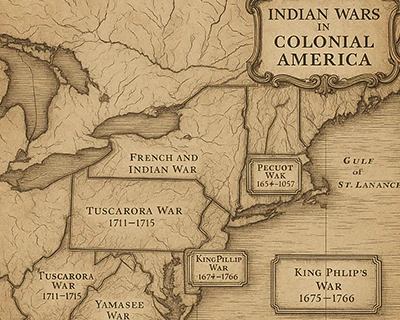
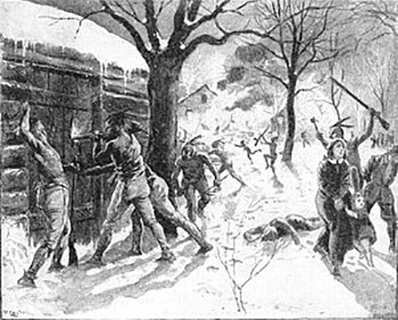
During the September 19, 1677 raid on Hatfield, Obadiah Dickinson was among seventeen people taken captive. The same attack killed Sarah Day Gunn Kellogg, mother of fifteen-year-old Samuel Gunn, together with her young son Joseph.^17
The two families therefore shared an experience of frontier violence generations before they became connected through marriage.
For the Dickinsons, Hatfield left a memory of captivity.
For the Gunns, it left a mother and child dead and a surviving son forced abruptly toward adulthood.
More than a century later the families met again: Lucretia Gunn married Samuel Fowler Dickinson; her brother Luther married Delia Dickinson; and subsequent generations carried both names forward.
That long arc gives the Gunn–Dickinson relationship unusual depth. It was not created in a single marriage. It emerged from families that had inhabited the same New England landscape, endured some of the same historical shocks, and eventually became joined by blood.
A Life Remembered Without a Grave
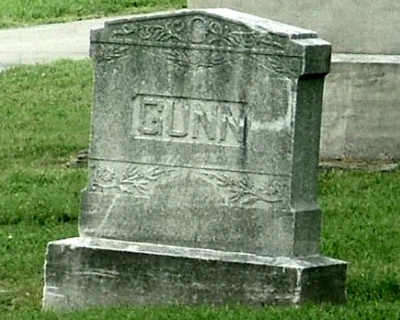
Dr. Luther Gunn’s physical memorial is uncertain.
At the time of his death, Pittsfield’s Old Burial Ground at the Common served the community. As Pittsfield subsequently reorganized its burial grounds, older remains were moved, and documentation of individual reinterments was incomplete. No securely identified surviving gravestone for Luther Gunn is presently known.
The absence is strangely appropriate to the historical problem he represents.
We know him through fragments: a church death record, family histories, his widow, his children’s lives, the military history of the town in which he practiced, and the extraordinary families connected to him.
Yet those fragments reveal something larger.
Dr. Luther Gunn was born into a family shaped by the Revolution. He became a physician in the young republic. War came to his community not principally through cannon fire but through soldiers, prisoners, sickness, and death. He died while his children were still infants, but his family continued in two remarkable directions.
Through his son Luther Dickinson Gunn, the line moved west and produced Amos Dewey Gunn.
Through his sister Lucretia Gunn Dickinson, the line entered the Amherst household into which Emily Dickinson was born.
Luther Gunn’s life was brief. Its connections were not.
Family
Parents
- Captain Nathaniel Gunn
- Hannah Montague Gunn
Sister of particular historical significance
- Lucretia Gunn (1775–1840)
- married Samuel Fowler Dickinson (1775–1838)
- son: Edward Dickinson (1803–1874)
- granddaughter: Emily Dickinson (1830–1886)
Wife
- Delia Dickinson (1792–1881)
- daughter of Jehu Dickinson and Eleanor Pomeroy
Children
- Sarah Ann Gunn (1812–1890), later Garvin and McConnel
- Luther Dickinson Gunn (1814–1906)
- married Emirancy Collins
- father of Amos Dewey Gunn and other children
Research Notes
Birth date: Unresolved. A nineteenth/early-twentieth-century biography of Luther Dickinson Gunn gives his father’s birth as September 1782 at Montague. The First Church of Pittsfield death transcription gives Dr. Luther Gunn’s age as twenty-six in August 1814, implying approximately 1787/88. Until a primary birth or baptismal record is located, both pieces of evidence should be retained.
Medical training: No primary documentation of a medical degree, medical school, apprenticeship, or preceptor has yet been identified. His profession and active practice as a physician are independently supported by the later biography of his son and the contemporary church death entry identifying him as “Dr. Luther Gunn.”
Military service: No evidence presently establishes an enlistment, commission, or formal appointment as a military surgeon. His documented status is that of a civilian physician practicing in Pittsfield during the operation of the U.S. cantonment and prisoner-of-war depot. The assertion that he contracted his fatal illness specifically while treating prisoners should remain identified as plausible family tradition unless further documentation is discovered.
Cause of death: The First Church transcription says “Typhus fever.” Later family tradition identifies typhoid. Because historical diagnostic terminology was inconsistent, the website should preserve the contemporary wording while explaining the later tradition.
Related Articles
- Lucretia Gunn Dickinson: The Gunn Grandmother of Emily Dickinson
- Emily Dickinson and the Gunn Family
- Samuel Gunn and the Hatfield Raid of 1677
- Obadiah Dickinson: Captivity at Hatfield
- Pittsfield and the War of 1812
- Luther Dickinson Gunn: From Massachusetts to Illinois
- Amos Dewey Gunn
- The Gunns in the American Revolution
Endnotes
- History of Putnam County, Illinois, biographical sketch of Luther Dickinson Gunn, gives Luther Gunn Sr. as born at Montague in September 1782; Records of the First Church, Pittsfield, Massachusetts, record his 1814 death from “Typhus fever” at age twenty-six. The conflict remains unresolved.
- Emily Dickinson Museum, “Samuel Fowler Dickinson (1775–1838) and Lucretia Gunn Dickinson (1775–1840), grandparents.” The Museum identifies Lucretia as a Gunn of Montague, records her 1802 marriage to Samuel Fowler Dickinson, and describes Samuel Fowler’s civic and educational career.
- Emily Dickinson Museum, “Emily Dickinson: Her Childhood and Youth, 1830–1855.” Emily was born December 10, 1830, in the Homestead, where Samuel Fowler and Lucretia Gunn Dickinson were then living.
- The relationship follows directly from Lucretia Gunn Dickinson’s position as Emily’s paternal grandmother and Luther Gunn’s identification as Lucretia’s brother: Luther was the brother of Emily’s grandmother, conventionally her great-uncle.
- Emily Dickinson Museum, “The Homestead.” The house was constructed about 1813 for Samuel Fowler Dickinson and Lucretia Gunn Dickinson and became Emily Dickinson’s birthplace and principal home.
- History of Putnam County, Illinois, sketch of Luther Dickinson Gunn: Delia Dickinson was born December 6, 1792, at Whately, Massachusetts, daughter of Jehu and Eleanor (Pomeroy) Dickinson.
- Ibid. The biography records Sarah Gunn’s birth as August 26, 1812, and Luther Dickinson Gunn’s birth at Pittsfield on July 28, 1814.
- Spencer Ellsworth, Record of Olden Times, biographical sketch of Luther D. Gunn; later Putnam County biography. Luther Dickinson Gunn migrated to Putnam County in June 1836, worked as a carpenter, settled at Granville, and married Emirancy Collins in 1840.
- History of Putnam County, Illinois, sketch of Luther Dickinson Gunn: “Luther Gunn, Sr., was a physician by profession and was practicing at the time of his death.” The First Church record independently styles him “Dr. Luther Gunn.”
- J. E. A. Smith, The History of Pittsfield (Berkshire County), Massachusetts, from the Year 1800 to the Year 1876, chap. 10, “War of 1812—Cantonment and Depot for Prisoners of War.” Pittsfield served as a military cantonment, recruiting center, and POW depot.
- Ibid. In August 1813 the Pittsfield barracks were ordered prepared for six hundred prisoners, including guarded accommodations and facilities for their confinement.
- United States military records summarized in scholarship on American POW policy document supplies for 924 British prisoners at Pittsfield during September–November 1814 and describe the cantonment’s barracks, officers’ quarters, hospital, kitchen, and guardhouse.
- No military commission or Army medical appointment for Luther Gunn has been identified in the sources reviewed. The connection between his medical practice and wartime disease exposure should therefore be treated as contextual rather than as proven formal military service.
- Records of First Church, Pittsfield, transcription copied by Rollin Hillyer Cooke, 1814 deaths: “Aug 6 Dr. Luther Gunn Typhus fever Aged 26 yrs.”
- History of Putnam County, Illinois, sketch of Luther Dickinson Gunn, states that his father died when Luther was approximately one week old.
- Ibid. Following Luther Gunn’s death, Delia returned to her parents and later married Levi Gunn, identified as a second cousin of her first husband; the second marriage produced eight children.
- Sylvester Judd, revised by Lucius M. Boltwood, History of Hadley, Including the Early History of Hatfield, South Hadley, Amherst and Granby, Massachusetts (Springfield, Mass., 1905), account of the Hatfield raid of September 19, 1677. Obadiah Dickinson was among the captives; Sarah, wife of Samuel Kellogg, and her child Joseph were among those killed.