





Deacon Nathaniel Gunn (1693–1779)
Fourth Generation | Hatfield, Sunderland, and Montague, Massachusetts
- Born: 31 July 1693, Hatfield, Massachusetts Bay Colony
- Died: 29 November 1779, Montague, Massachusetts
- Parents: Deacon Samuel Gunn (1662–1755) and Elizabeth Bronson Wyatt
- Grandparents: Nathaniel Gunn (c. 1637–1663) and Sarah Day
- Great-grandfather: Dr. Jasper Gunn (1607–1671)
- Spouses: Hannah Dickinson (d. 1721); Esther Belden (c. 1697–?); Hannah (surname uncertain, d. 1783)
- Occupation: Community and religious leader; secular occupation not established
- Known for: Religious leadership and participation in the settlement and development of Montague, Massachusetts
A Life Along the Connecticut River
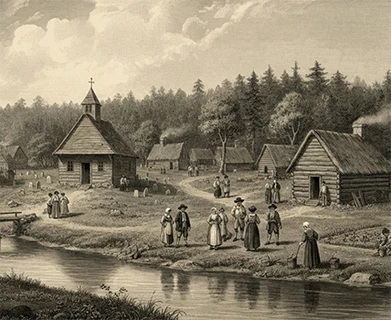
By the time Nathaniel Gunn was born in Hatfield, Massachusetts, in July 1693, the Gunn family had been in New England for nearly sixty years. The experiences of his great-grandfather, Dr. Jasper Gunn, who arrived from England in 1635, belonged to an earlier generation. The uncertainty of ocean crossings and the establishment of the first Puritan settlements had given way to the continuing work of building communities along the Connecticut River.
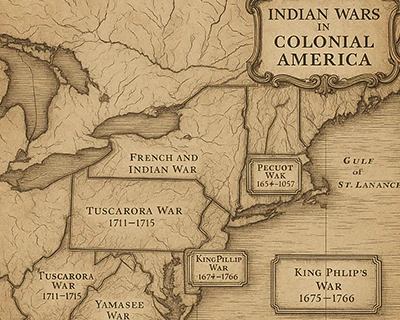
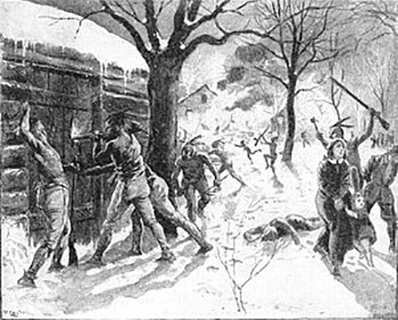
Nathaniel was born into a family that knew both the opportunities and hardships of colonial life. His father, Deacon Samuel Gunn, had survived the Indian attack on Hatfield in September 1677, during which Samuel’s mother, Sarah Day Gunn Kellogg, was killed. Samuel later became a prominent member of Sunderland, Massachusetts, where he served as a deacon and participated in town affairs.
The younger Nathaniel inherited something more enduring than the family name. He grew up in a household where religious observance, civic responsibility, and the obligations of community were closely connected. These principles would remain central to his own life.
Unlike his great-grandfather Jasper, Nathaniel did not have to establish a home in an unfamiliar country. Nor did he face the same immediate dangers that had shaped his father’s youth. His generation inherited communities that had already taken root, but whose institutions and boundaries were still developing.
Nathaniel would devote much of his long life to that continuing work.
Family and Marriage
Nathaniel’s first marriage, to Hannah Dickinson on 29 December 1720, was brief and marked by tragedy. Hannah gave birth to a daughter in October 1721 but died on 4 November, reportedly thirteen days after the birth. The infant survived her mother by only eleven days, dying on 15 November.
Within a matter of weeks, Nathaniel had lost both his wife and child.
In November 1724, Nathaniel married Esther Belden, sometimes recorded as Esther Belding, daughter of Stephen Belden and Mary Wells of Hatfield. Their marriage united two families long established in the Connecticut River Valley.
Together, Nathaniel and Esther raised the family through which the Gunn name continued into the next generation. Their sons would become soldiers, religious leaders, tradesmen, and participants in the expansion of western Massachusetts.
Esther’s date of death has not been firmly established. Nathaniel subsequently married a third wife named Hannah, who died in February 1783. Some genealogical research identifies her tentatively as Hannah Wells of Colchester, Connecticut, but the evidence remains insufficient to establish her maiden name with certainty.
Nathaniel’s marriages spanned several decades, during which Sunderland and the neighboring settlements continued to grow. Family life was closely connected to the surrounding community. Children were raised within networks of relatives, neighbors, and congregations, while marriages often linked families whose histories reached back to the earliest settlements of the Connecticut River Valley.
The Children of Nathaniel and Esther
The revised Gunn family genealogy identifies five sons of Nathaniel and Esther Belden.
Nathaniel Gunn Jr. (1726–1807) was born on 24 January 1726. He married Dorothy Montague Marsh and became both a lieutenant and a deacon. His military service during the American Revolution and his participation in religious affairs continued the family tradition of public responsibility. Through Nathaniel Jr., the direct Gunn lineage followed in this book continued to Deacon Elihu Gunn (1763–1851).
Moses Gunn (1727–1727) was born on 28 October 1727 and died in infancy. The name Moses was subsequently given to another son, following a common New England practice of preserving the names of deceased children.
Moses Gunn (1728–1793) was born on 12 October 1728 in Sunderland. He is identified in Franklin Bowditch Dexter’s biographical history of Yale College among the members of the class of 1748. On 17 June 1790, he married Eleanor Ingram (1754–1814) in Montague. He died on 3 January 1793, less than three years after their marriage. His inclusion in the Yale biographical record provides an important opportunity for further research into the educational and intellectual experiences of the Gunn family.
Asahel Gunn (1730–1796) was born in November 1730 and married Thankful Marsh in 1751. He became associated with the development of Montague, serving as a keeper of the town meetinghouse. His wife is remembered in local histories for her work in early education. Their household represents another example of the family’s involvement in the religious and civic institutions of the Connecticut River Valley.
Elisha Gunn (1733–1769) was born on 16 January 1733 in Hatfield. He married Esther Sawyer and became a gunsmith and interpreter of Haudenosaunee languages. During the 1760s, Elisha worked with Protestant missionary organizations among Native American communities, particularly at Onaquaga, in present-day New York. His linguistic abilities made him a valuable intermediary between missionary societies and the communities in which they operated. His surviving correspondence with Eleazar Wheelock provides an unusual documentary record of a Gunn family member whose work extended well beyond the Connecticut River Valley. Elisha died on 17 March 1769, aged thirty-six.
The differing pursuits of these sons illustrate the opportunities available to successive generations of the Gunn family. Religious service remained important, but the family was no longer confined to the occupations and circumstances of its earliest ancestors.
A Deacon and Community Leader
Nathaniel was remembered principally for his religious service.
In eighteenth-century New England, the church occupied a central place in community life. Religious observance was closely tied to education, charity, social relationships, and the conduct of public affairs. The meetinghouse was more than a place of worship. It was an institution around which much of a town’s common life revolved.
The office of deacon carried particular responsibilities. Deacons assisted with the practical needs of their congregations, supported the administration of church affairs, and helped maintain the relationships that held the religious community together.
Nathaniel approached these responsibilities with unusual dedication.
An early history of the Gunn family records that he made it his practice to visit every family in his community at least once a week, offering to pray with the household if permission was given.
The account is striking for its simplicity. It describes neither a dramatic public achievement nor a position of great authority, but an ordinary practice repeated over many years. If accurately preserved, it suggests a man whose understanding of religious responsibility extended beyond the meetinghouse and into the homes of his neighbors.
The same family history describes Nathaniel as a prominent citizen and a leader in both church and town affairs.
Religious leadership was already a family tradition. His father Samuel had served as a deacon in Sunderland, and his son Nathaniel Jr. would likewise hold the office. Across three generations, the title reflected a continuing commitment to the religious life of the communities in which the family lived.
The surviving evidence tells us less about Nathaniel’s livelihood. Sunderland and Montague were agricultural communities, and farming formed the foundation of much of their economy. However, a contemporary document establishing Nathaniel’s specific occupation has not yet been identified. His work as a deacon and community leader is better documented than the means by which he supported his household.
Sunderland and the Founding of Montague
During Nathaniel’s lifetime, settlement continued to spread along the Connecticut River and into the surrounding countryside.
Sunderland, where his father had established the family, became an important center for the next generation of Gunn descendants. As families grew and land was occupied farther from the original settlement, new communities emerged. Among them was Montague, incorporated as a separate town in 1754.
An early Gunn family history identifies Nathaniel as one of the builders and founders of Montague. Although the precise extent of his involvement requires further examination of town records, the account places him among those who contributed to the community’s development.
The creation of a town involved more than clearing land and constructing houses. Roads had to be established, property boundaries recognized, schools organized, and places of worship maintained. Local government required men willing to assume responsibilities that were often time-consuming and offered little financial reward.
Nathaniel’s reputation for service suggests that he belonged to the generation that helped transform the region from scattered settlements into an established network of towns.
His family’s participation extended beyond his own lifetime. Asahel served in connection with Montague’s meetinghouse, while Nathaniel Jr. and other descendants assumed military, religious, and civic responsibilities.
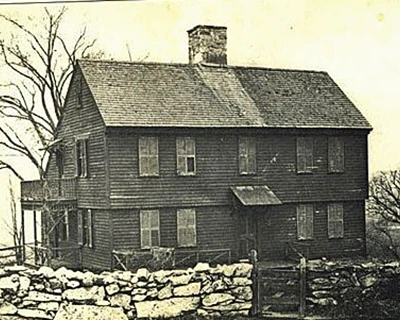
An earlier family history also records that Nathaniel’s old home in Sunderland remained standing until 1875, when it was destroyed by fire. The survival of the house for so long offers a tangible reminder of the family’s place in the community. Long after Nathaniel’s death, the structure remained part of the landscape known to succeeding generations.
From Jasper Gunn’s participation in the settlement of Milford to Samuel’s involvement in Sunderland and Nathaniel’s association with Montague, the family continued to contribute to the establishment and maintenance of New England communities.
Each generation inherited the work of the one before it, carrying that responsibility into a changing world.
The Revolutionary Generation
Nathaniel lived long enough to witness another fundamental change in American life.
When he was born in 1693, Massachusetts was an English colony governed under a royal charter. By the final years of his life, the thirteen colonies had declared their independence and were engaged in a war that would determine their political future.
Nathaniel was already in his eighties when the American Revolution began. The military responsibilities of the conflict fell largely to younger men, including members of his own family.
His son Lieutenant Nathaniel Gunn Jr. served in the Hampshire County militia during the Revolutionary period. Other descendants also participated in the war, carrying the family into a new era of American history.
For Nathaniel, the Revolution came near the end of a life spent within the institutions of colonial Massachusetts. He had witnessed the continuing expansion of settlement, the establishment of new towns, changes in religious practice, and finally the beginnings of a new nation.
The details of his own political views have not survived in the sources examined. His life nevertheless connected two distinct periods of American history: the frontier communities of the late seventeenth century and the revolutionary society of the late eighteenth.
Death and Legacy
Deacon Nathaniel Gunn died on 29 November 1779, aged eighty-six. His death is generally associated with Montague, Massachusetts.
By then, the Gunn family had been established in New England for nearly a century and a half. The descendants of Jasper Gunn had moved beyond Milford into the Connecticut River Valley, where successive generations had helped build and sustain communities.
Nathaniel’s own life was not distinguished by a single extraordinary event. Unlike his great-grandfather, he had not crossed the Atlantic to begin a new life in an unfamiliar country. Unlike his father, he was not remembered as a survivor of frontier violence. Nor did he leave behind a record of military service comparable to that of his son.
His contribution was quieter, but no less important to the continuing family story.
He helped preserve the institutions upon which his community depended. His religious service, participation in town affairs, and responsibilities as a husband and father formed part of the work through which colonial settlements became enduring towns.
The lives of his children also reflected an expanding world. Nathaniel Jr. carried the family into the Revolutionary generation. Moses entered the historical record of Yale College. Asahel participated in the civic and educational life of Montague. Elisha traveled beyond Massachusetts, working as a gunsmith and interpreter among Native communities.
The Gunn family was changing, as was the country around it.
In the generations that followed, Nathaniel’s descendants would move westward into New York, Ohio, Illinois, and beyond, carrying with them traditions rooted in the communities of colonial New England.
Deacon Nathaniel Gunn belongs among those ancestors whose lives explain how a family endured. He inherited a place in a community that earlier generations had struggled to establish, and he contributed to the work of preserving it for those who followed.
His was a generation of consolidation and continuity.
The River continued.
Sources and Endnotes
-
Hatfield, Massachusetts, town records. Births, Marriages, and Deaths in Four Massachusetts Towns, 1655–1844, transcribed birth entry for Nathaniel Gunn, son of Samuel and Elizabeth Gunn, 31 July 1693. Referenced in the WeRelate genealogical database.
-
The Gunns, pp. 68–69. Early family history recording Nathaniel’s parentage, marriages, children, religious activities, involvement in Montague, and former Sunderland home. Available through Seeking My Roots and Electric Scotland.
-
Paul J. McCarthy, Descendants of Nathaniel Gunn and Esther Belden, Volume I: Five Generations (January 2002), p. 1. Provides genealogical information concerning Nathaniel’s three marriages, the deaths of Hannah Dickinson and her infant daughter, and the possible identity of his third wife.
-
Daniel White Wells and Reuben Field Wells, A History of Hatfield, Massachusetts (1660–1910) (Springfield, Massachusetts: F. C. H. Gibbons, 1910), p. 375. Identifies Esther Belden, daughter of Stephen Belden and Mary Wells, as the wife of Nathaniel Gunn of Sunderland.
-
John Montague Smith et al., History of the Town of Sunderland, Massachusetts, 1673–1899 (Greenfield, Massachusetts: E. A. Hall & Co., 1899). Provides historical and genealogical context for the Gunn and Belden families.
-
Edward P. Pressey, History of Montague: A Typical Puritan Town (1910). Documents the town’s settlement, development, churches, and civic institutions.
-
Franklin Bowditch Dexter, Biographical Sketches of the Graduates of Yale College, Volume II. Entry for Moses Gunn, class of 1748.
-
Dartmouth College, The Occom Circle, “Gunn, Elisha,” and “Elisha Gunn, Letter to Eleazar Wheelock, 2 September 1767.” Documents Elisha’s occupation, interpretation work, and correspondence with the missionary network surrounding Eleazar Wheelock.
-
Gunn family genealogical records, including records for Nathaniel Gunn Jr., Moses Gunn, Asahel Gunn, and Elisha Gunn. Family relationships, marriages, and vital dates are subject to confirmation against original town, church, probate, and cemetery records.
Research Notes
Birth date: The Hatfield town-record transcription gives 31 July 1693, while an early Gunn family history gives 30 July. The town-record transcription is preferred provisionally.
Children: The revised working genealogy includes five sons of Nathaniel and Esther Belden. Some secondary genealogies also identify a daughter Esther Gunn, born in 1736. She is excluded from this narrative pending further examination of the records. Separately, Esther Sawyer, widow of Elisha Gunn, may be the widow Esther Gunn who married Elijah Remington in 1771.
Third marriage: Hannah Wells remains a proposed identification for Nathaniel’s third wife, not an established genealogical conclusion.
Occupation: Nathaniel’s religious and civic contributions are described in early family histories, but his secular occupation and specific municipal offices require additional documentation.
Birth dates of children: Published compilations disagree on certain dates, particularly those of Moses, Asahel, and Elisha. The dates presented follow the revised working genealogy where specified.