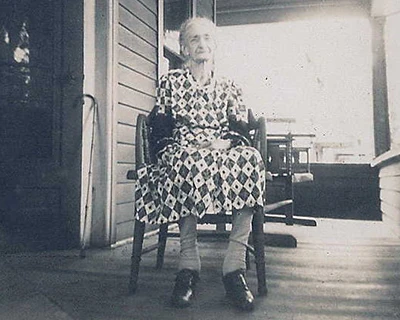
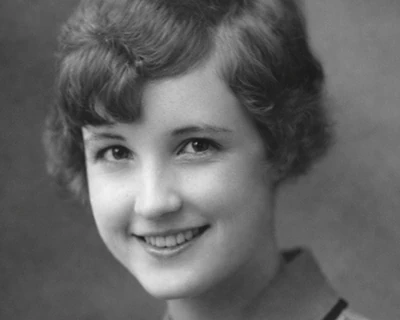
Nina Belle Gunn Pyle
Teacher, Mother, and Keeper of a Family's Memory
Nina Belle Gunn Pyle (1877–1941)
Biography
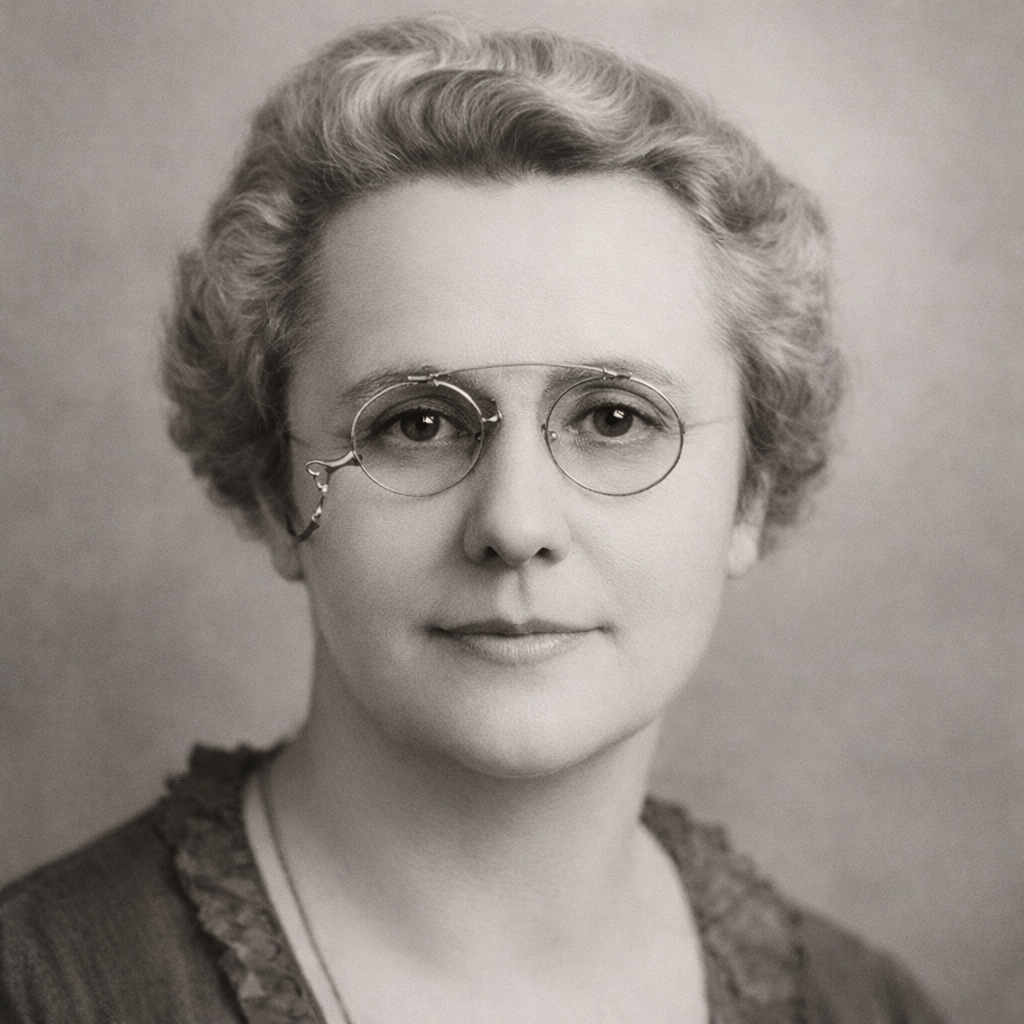
Nina Belle Gunn Pyle
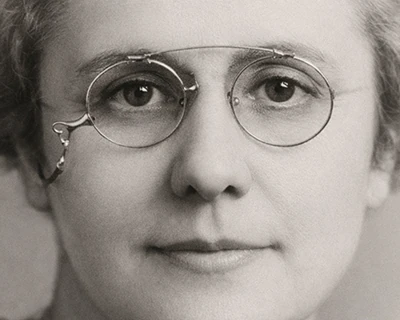
Nina Belle Gunn Pyle stands near the end of the direct family line traced in The Gunns in America, but her life is not merely an ending. It is a point of passage. Through her, the story moves from the nineteenth-century frontier into modern America—from a Nebraska homestead and a one-room school to a public library, the automobile age, the Great Depression, and a family whose children would carry their inheritance into teaching, farming, art, public service, and war.
She was born in Illinois on December 5, 1877, the daughter of Aaron Elihu Gunn and Mary Ann “Polly” Williams Gunn. Her father descended in a documented line from Jasper Gunn, who reached New England aboard the Defence in 1635. Her mother was the English-born daughter of a Baptist minister, educated at a girls’ boarding school and widely read in English literature and history. Nina therefore inherited two strong traditions: the Gunn family’s long association with faith, education, and public responsibility, and the Williams family’s culture of reading, music, and disciplined learning.[^1]
Nina’s life was repeatedly shaped by loss. At twelve, she lost her father to a winter accident on Lodgepole Creek. Nearly three decades later, her eldest child, Albert Lawrance “Laurie” Pyle, died in an automobile accident at eighteen. The circumstances were different, but the echo is unmistakable: first a daughter left without her father, then a mother left without her son. Between those two tragedies, Nina became a teacher, wife, mother, and civic worker. Her achievement was not that sorrow passed her by. It was that she continued to build a life around learning, family, and community after sorrow had entered it.
From Illinois to Western Nebraska
Nina was born while her father operated a dairy in La Salle, Illinois. Aaron Elihu Gunn had studied at Hillsdale College and worked as a telegrapher before turning to the dairy business. His wife, Mary Ann, brought to the household an education unusual for many women of her generation: she played the organ, sang, read the English classics, and knew English history.[^2]
The family had already endured the deaths of two infant sons before Nina’s birth. She became the eldest surviving child, followed by Winifred Elsie, Effie Margaret, Claude Williams, and Beulah Lucy Gunn.
In 1886, Aaron left the dairy and moved his family west to Deuel County, Nebraska. Near the newly developing railroad town of Chappell, he took up a 160-acre homestead and purchased additional partially irrigated land along Lodgepole Creek. He built a small frame house with an attic and cellar, a sod barn, a chicken coop, a windmill, and a granary. The family’s furniture, books, organ, and household goods gave the small dwelling some of the character of the home they had left behind, but Mary Ann found the country lonely and severe.[^3]
For nine-year-old Nina, the move brought a childhood very different from the settled Illinois community she had known. The work of a western homestead demanded the labor of the whole household. Water, livestock, crops, food preparation, laundry, and younger children required constant attention. Later family recollections remembered that the older Gunn girls helped milk cows, feed animals, pump water, tend chickens, and keep the household running.[^4]
Aaron loved Nebraska. He taught at the nearby country school and preached in Chappell, extending the family’s older traditions of education and religious service into the new community. His life there, however, was brief.
The Death of Her Father
During the winter of 1890, Aaron attempted to cross the dam he had built on Lodgepole Creek. The ice gave way over running water, and his heavy winter clothing made escape impossible. He drowned at forty-two.[^5]
Nina was twelve years old.
The accident left Mary Ann with five surviving children, land that could not readily be sold, and little cash. She sold Aaron’s gold watch to pay for his funeral. Relatives urged her to abandon Nebraska and return east, even proposing that the children be divided among family members. She refused.
That refusal preserved the household, but it did not remove its burdens. Nina, as the eldest surviving child, was old enough to understand both the grief and the practical danger facing the family. The records do not tell us precisely how the loss changed her, and we should not invent thoughts she did not leave behind. They do show that responsibility came early.
In January 1892, Mary Ann married Henry George Wiegand, a German immigrant and neighbor who had helped the family after Aaron’s death. Wiegand expanded the house, improved the farm buildings, and purchased Mary Ann’s interest in the Gunn property under an arrangement that promised each of the five Gunn children $300 upon reaching eighteen.[^6]
Family memory preserves a small but revealing story from these years. When Nina needed four dollars7 before receiving her first teacher’s pay, her stepfather lent it to her and required her to sign a note. Nina climbed to the top shelf where he had placed the paper and tore it up. When Wiegand asked whether she would like him to do the same with the agreement promising her $300, she understood the lesson and signed a new note.[^7]
The story is affectionate rather than severe. It shows a spirited young woman learning that independence rested upon responsibility.
A Teacher at Seventeen
Nina began teaching at seventeen in the Spann school district, eight miles from the family home. She rode a horse named Prince to the school and returned home on weekends.^8
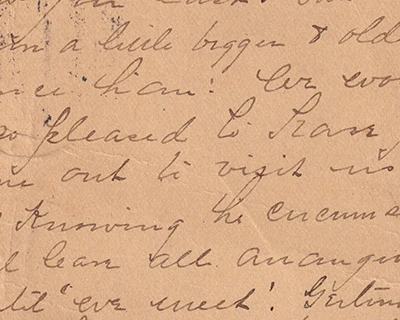
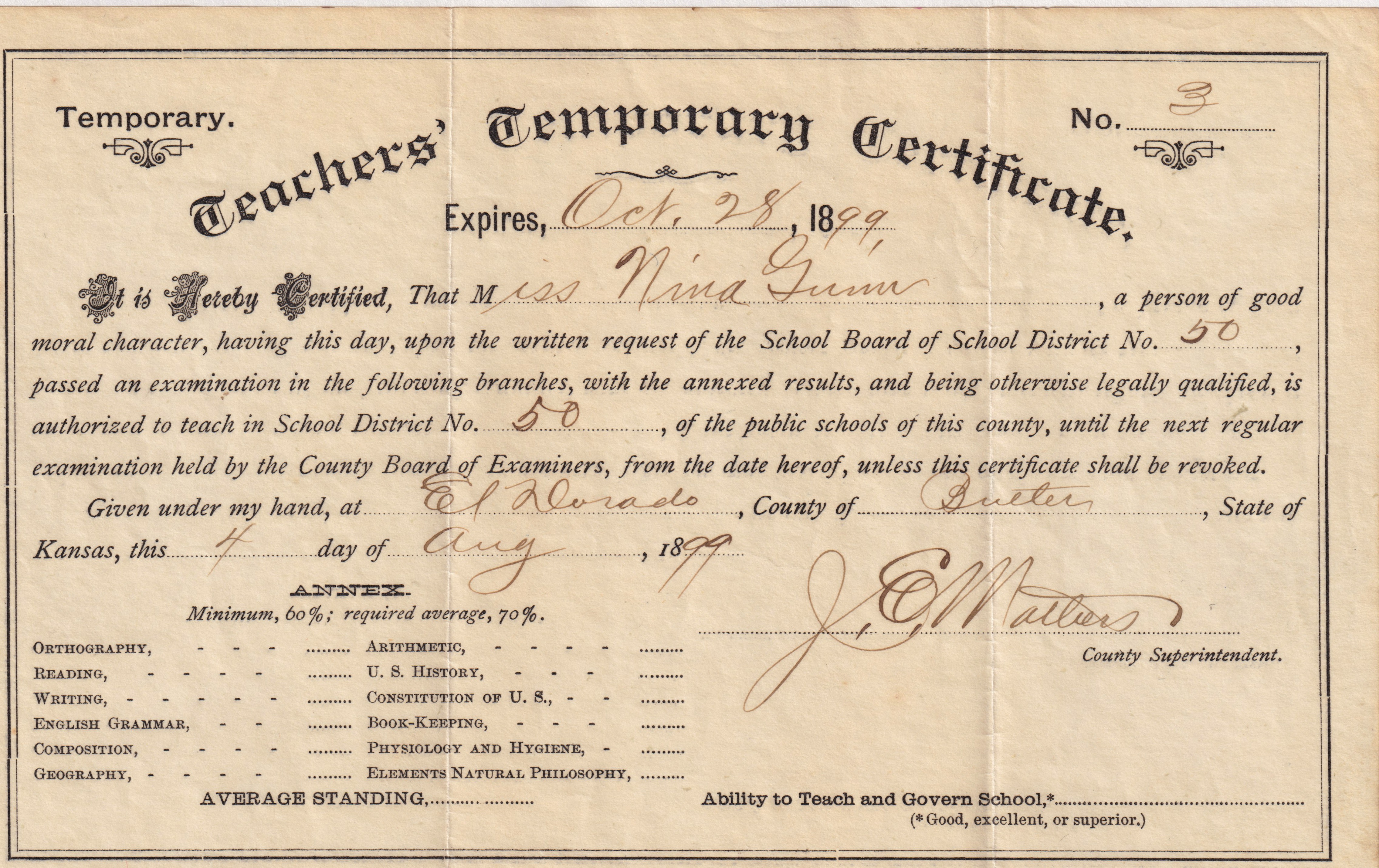 Nina Gunn’s teaching certificate, 1899
Teaching offered young women on the Plains one of the few respectable ways to earn wages outside the household. The work required mastery of a broad curriculum and the ability to manage children of different ages and levels in a single room. A teacher might also board near the school during the week, maintain the stove, organize recitations, and serve as one of the few formally educated figures in an isolated district.
Nina’s work belonged to a larger family pattern. Her father had taught near Chappell, and her mother’s education shaped the intellectual life of the home. In an earlier generation of the extended Gunn family, Thankful Marsh Gunn was remembered as the teacher of Montague’s first school. Nina’s career should not be turned into a claim that every Gunn woman taught, but it does show the recurrence of education as a form of service across generations.
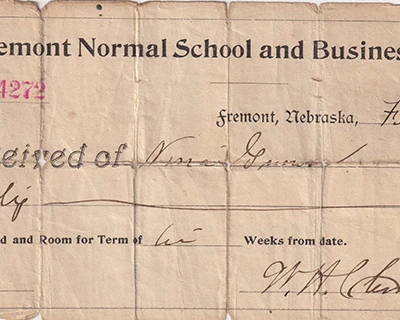
The chapter account records that Nina attended Fremont Normal School and later taught in Kansas, including at Indianola.[^9] Normal schools were created specifically to prepare teachers, emphasizing subject knowledge, classroom practice, and the disciplined routines required in public education. Nina’s training distinguished her from those rural teachers who entered the classroom with little preparation beyond their own schooling.
At eighteen, she received the $300 promised under the family property agreement and left Nebraska for Kansas. She stayed with her aunt Elizabeth “Lizzie” Gunn Ayres near Augusta, worked as a teacher, and began the next stage of her life.[^10]
Marriage and Family
On June 10, 1900, Nina married William Harrison Pyle at Augusta, Kansas.[^11] William, commonly called Will, had been raised in Kansas and worked in agriculture. Their marriage joined the Gunn family’s Nebraska story to the Pyle family of Kansas.
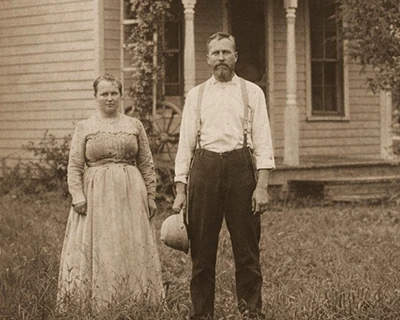
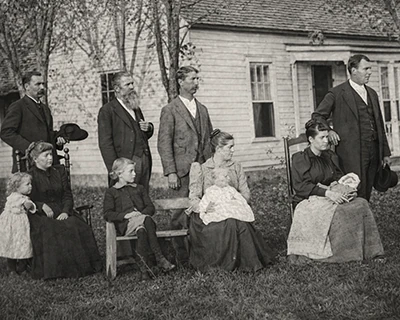
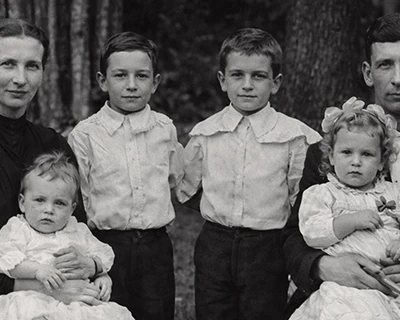
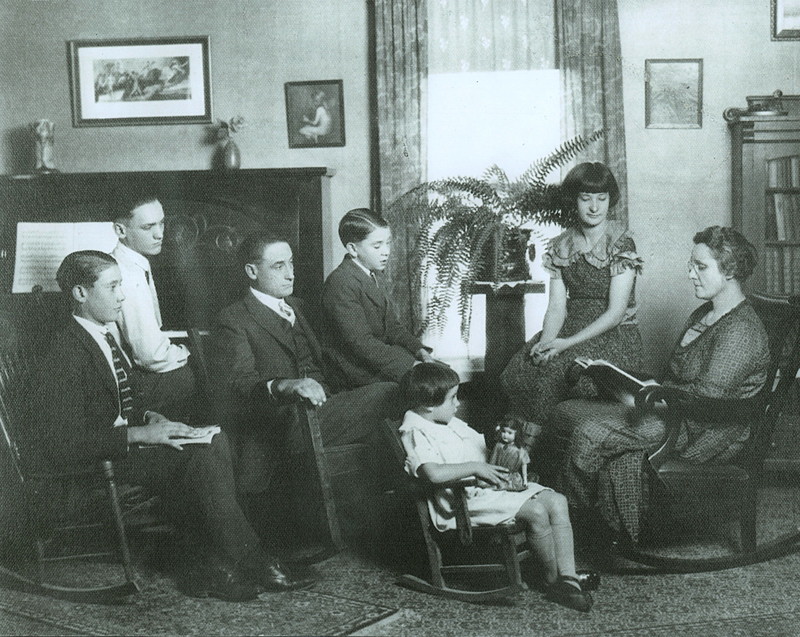 The William and Nina Pyle family
Nina and Will became the parents of six children:
- Albert Lawrance “Laurie” Pyle, their eldest child.
- Eugene Harrison Pyle, who entered the electrical trade and later contributed to the civic and utility life of Chappell.
- Josephine Mary Pyle, who continued the family’s teaching tradition.
- Aaron Gunn Pyle, the farmer and Regionalist painter whose work preserved the people and landscape of western Nebraska.
- William Henry “Bill” Pyle, whose adult life included military technical service during the Second World War.
- Catherine Joan Pyle, born in 1918, through whom Nina’s line continues to the author of The Gunns in America.[^12]
The family initially lived in Kansas. They later returned to the Chappell area with their four oldest children and lived for a time on the Wiegand ranch. Two more children, William and Catherine, completed the household. Nina had crossed from Nebraska to Kansas in search of opportunity; her return brought the family story back to the place where her father had died and where her own character had been formed.
Her younger half-sister Jessie Wiegand Hosford remembered Nina’s kindness with unusual clarity. Before Jessie left for Kearney to complete high school, Nina gave her a going-away party. She painted small traveling satchels on paper for invitations and served what Jessie remembered as “fancy refreshments.” Decades later, Jessie wrote that it was the only party anyone had given her until her eightieth birthday.[^13]
It is a modest recollection, but it reveals something official records cannot. Nina understood the meaning of departure and marked it with care. The teacher made the occasion; the older sister made the younger one feel seen.
The Death of Laurie
In 1919, Nina and Will’s eldest child, Laurie, was killed in an automobile accident. He was eighteen.[^14]
The automobile represented mobility, modernity, and freedom for a rising generation. It also introduced a new form of sudden death into American family life. For Nina, the news reopened a pattern that had begun beside Lodgepole Creek in 1890. She had lost her father without warning when she was twelve. Now, at forty-one, she lost her eldest child without warning.
Jessie described Laurie’s death simply as “a real tragedy in Nina’s life.” That restraint should be respected. No surviving letter records Nina’s grief in her own words. Yet the parallel belongs in her biography because it shaped the architecture of her life. The child who had watched her mother hold a family together after a fatal accident became the mother required to continue after another.
The echo does not mean the two losses were identical. It means that sudden death returned in a new generation. The River does not repeat itself—but its patterns return.
Education as Civic Work
Nina’s commitment to learning did not end when she left the classroom.
On August 1, 1920, the Chappell Public Library began operating in the Deuel County Courthouse. A published history of the institution identifies Nina Gunn Pyle and Robert McGrale as members of its first board.[^15] This is an important addition to her record. It places her not only within her own household but within the civic development of Chappell.
In a small Plains town, a public library was more than a collection of books. It was an assertion that access to knowledge belonged to the community. Nina had taught children in rural schools; as a library trustee, she helped extend education beyond the classroom and across a lifetime.
The service also connects several elements of her inheritance. Her mother had carried English books and learning into a Nebraska homestead. Her father had taught and preached. Nina taught, raised children, and helped establish a public institution devoted to reading. Education in her life was not merely personal advancement. It was a public good.
Through the Great Depression
By the time the Great Depression began, Nina and Will had moved from the demands of raising young children into the more complicated work of guiding an adult family. Their Nebraska community was struck by both economic collapse and environmental hardship. Across the Great Plains, falling farm prices, debt, drought, and dust compounded one another. Nebraska histories remember “sharing” and “making do” as central facts of Depression life.[^16]
The surviving family record does not provide a household ledger for Nina and Will, nor does it establish a foreclosure, relief payment, or single crisis that can safely be assigned to them. Their Depression experience should therefore not be dramatized beyond the evidence. What can be said is that their household remained rooted in an agricultural community at the center of the crisis.
The lives of their children show the family adapting. Eugene developed practical electrical skills and became associated with the local utility world. Josephine taught. Aaron divided his life between farm labor and art, eventually studying with Thomas Hart Benton while remaining deeply attached to the land around Chappell. William entered adulthood in the Depression decade and later served in a technical military role during the Second World War. Catherine, the youngest, came of age as the country moved from economic emergency toward war.[^17]
Nina’s contribution during these years is easily obscured because much of it took place inside the household and family network. She helped sustain a home in which education, practical work, and creative ability could coexist. One son became a recognized painter not by escaping the farm but by learning to see it. A daughter continued the teaching tradition. Other children carried technical competence into the rapidly changing world of electricity, machinery, and wartime service.
This was not a retreat from history. It was one of the ways families endured it.
Final Years and Death
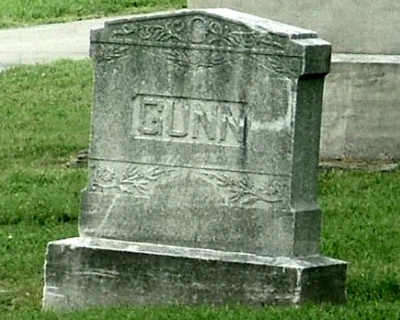
Nina spent her later years at Chappell, surrounded by the community that had shaped her adolescence and adult life. She also acted as a keeper of family memory. After returning from Kansas, she arranged for a stone to be placed on her father Aaron Elihu Gunn’s grave in the Chappell Cemetery.[^18] The act was small but consequential. Aaron’s life had ended suddenly, and the family had once lacked even the money for his funeral. His daughter ensured that his resting place would be marked.
Nina died at Chappell on April 3, 1941, at sixty-three. She was buried in Chappell Cemetery.[^19] William survived her by more than two decades.
Her death came before the United States entered the Second World War, but her children would carry the family into that new era. She did not live to see the full recognition eventually given to Aaron Gunn Pyle’s art, the long careers of her other children, or the later generations descended through Catherine Joan Pyle. Yet the foundations of those lives had been laid in the world she maintained.
Legacy
Nina Belle Gunn Pyle’s biography is not organized around a single public achievement. Its meaning lies in continuity.
She was born into a family still carrying the habits of nineteenth-century religious and educational culture. She crossed the Plains as a child, lost her father on a Nebraska homestead, taught in a rural school at seventeen, pursued further education, and used her small inheritance to begin an independent life in Kansas. She married, raised six children, returned to Chappell, helped guide the town’s first public library, buried her eldest son, endured the Depression, and preserved her father’s grave.
Through her, the Gunn name ceased to be the surname of the direct line, but the inheritance continued. It passed through habits rather than labels: literacy, memory, responsibility, teaching, making, and the determination to hold a family together in difficult times.
The Gunn name is the spine, not the skin.
Nina’s life makes that distinction visible. She carried the family story forward not because every outward form remained unchanged, but because its deepest commitments survived within her household and passed to her children.
Timeline
- 5 December 1877 — Born in La Salle, Illinois, daughter of Aaron Elihu Gunn and Mary Ann Williams Gunn.
- 1886 — Moved with her family to a homestead near Chappell, Nebraska.
- Winter 1890 — Her father drowned after breaking through ice at his dam on Lodgepole Creek; Nina was twelve.
- January 1892 — Her mother married Henry George Wiegand.
- About 1894–1895 — Began teaching in the Spann school district at seventeen, riding eight miles and returning home on weekends.
- About 1895–1896 — Received the $300 promised from the Gunn property agreement and moved to Kansas to live with her aunt Lizzie Gunn Ayres.
- Late 1890s — Attended Fremont Normal School and taught in Kansas, including at Indianola.
- 10 June 1900 — Married William Harrison Pyle at Augusta, Kansas.
- 1901 — Birth of eldest son Albert Lawrance “Laurie” Pyle.
- Early twentieth century — Returned to the Chappell area with Will and their four oldest children; the family later numbered six children.
- 1918 — Birth of youngest child, Catherine Joan Pyle.
- 1919 — Laurie Pyle was killed in an automobile accident at eighteen.
- 1 August 1920 — Chappell Public Library opened in the Deuel County Courthouse; Nina Gunn Pyle served on its first board.
- 1930s — Lived through the Great Depression and Plains drought in the agricultural community of Chappell.
- 3 April 1941 — Died at Chappell, Nebraska, aged sixty-three; buried in Chappell Cemetery.
Family
Parents
- Aaron Elihu Gunn (1848–1890) — Teacher, telegrapher, dairyman, Nebraska homesteader, and lay preacher; drowned at his Lodgepole Creek dam.
- Mary Ann “Polly” Williams Gunn Wiegand (1853–1937) — English-born daughter of a Baptist minister; educated at a girls’ boarding school; married Henry George Wiegand after Aaron’s death.
Spouse
- William Harrison Pyle (1878–1965) — Kansas-born farmer; married Nina at Augusta, Kansas, on June 10, 1900.
Children
- Albert Lawrance “Laurie” Pyle (1901–1919) — Eldest child; killed in an automobile accident at eighteen.
- Eugene Harrison Pyle (1905–1992) — Electrician and Chappell civic figure.
- Josephine Mary Pyle Crose — Teacher; later mother by adoption.
- Aaron Gunn Pyle (1909–1972) — Farmer and Regionalist painter identified closely with the people and landscape of Nebraska.
- William Henry “Bill” Pyle (1913–1997) — Served in a technical role in the United States Army during the Second World War and later lived in Colorado.
- Catherine Joan Pyle Lumpp (1918–1972) — Worked at the Remington Arms plant in Denver during the Second World War; mother of John Paul Lumpp.
Related Articles
- Aaron Elihu Gunn: From Illinois to the Nebraska Frontier
- Mary Ann Williams Gunn Wiegand
- The Drowning at Lodgepole Creek
- Rural Schools on the Nebraska Plains
- The Founding of the Chappell Public Library
- The Great Depression in Western Nebraska
- Aaron Gunn Pyle: Painter of Nebraska
- Catherine Joan Pyle Lumpp
Sources & Further Reading
- Hosford, Jessie Wiegand. Some Things I Remember. Las Cruces, New Mexico, 1985. Family memoir. The most detailed surviving account of Nina’s childhood, first teaching position, move to Kansas, relationship with her younger siblings, Laurie’s death, and the marking of Aaron Elihu Gunn’s grave.
- Lumpp, John Paul. The Gunns in America. Chapter 22, manuscript in progress. Family narrative and compiled documentary research concerning Nina Belle Gunn Pyle and her children.
- United States census schedules for the Gunn, Wiegand, and Pyle households, 1880–1940. Dates, residences, household composition, and occupations should be cited to the individual schedules in the final editorial pass.
- Nebraska Library Commission. “The Western Sun,” article on the history of the Chappell Public Library. Identifies Nina Gunn Pyle and Robert McGrale as members of the library’s first board when it opened on August 1, 1920.
- Nebraska State Historical Society. “Depression Living.” Historical context for drought, scarcity, sharing, and “making do” in Nebraska during the 1930s.
- Nebraska Studies. “Tri-County Project: Drought and the Dust Bowl.” Historical context for the combined effects of agricultural depression and sustained drought in Nebraska.
- National Drought Mitigation Center, University of Nebraska–Lincoln. “The Dust Bowl.” Overview of the combined economic and environmental crisis affecting Great Plains farmers.
- FamilySearch Family Tree entries and attached records for Nina Belle Gunn Pyle and her children. Useful as a finding aid; each conclusion should be checked against the attached vital, census, marriage, and cemetery records.
- “Nina Belle Gunn Pyle.” Find a Grave. Memorial and grave-marker information giving her birth as December 5, 1877, and her death as April 3, 1941.
- “Aaron Elihu Gunn.” Find a Grave. Memorial and cemetery information, with family links. Derivative source; use in conjunction with cemetery or civil records.
- Public histories of Aaron Gunn Pyle held by the Museum of Nebraska Art and History Nebraska, for the later career of Nina’s son and the family’s connection to Nebraska Regionalism.
Research Notes
Birth date. Nina’s Find a Grave memorial gives December 5, 1877. That date is used in this biography. Jessie Wiegand Hosford’s family memoir gives December 4, an apparent one-day discrepancy preserved here as a source note.
Teaching is well supported, but the records are uneven. The Spann District appointment at seventeen, the eight-mile ride, and the weekly return home come from Jessie’s memoir. Fremont Normal School and the Kansas/Indianola teaching period are preserved in the book chapter and family research. A school catalog, teacher register, county superintendent’s report, or newspaper notice would strengthen those details.
The library trusteeship is a valuable new public record. The Nebraska Library Commission’s history states that the Chappell Public Library opened in the Deuel County Courthouse on August 1, 1920, with Nina Gunn Pyle and Robert McGrale serving as the first board. The original municipal minutes or library accession record should be sought for a primary citation.
Laurie’s accident should be documented from a contemporary source. Jessie’s memoir securely preserves the family memory that Laurie died in an automobile accident at eighteen in 1919. A death certificate, coroner’s record, or Chappell newspaper account should be obtained before adding details about the location or circumstances.
The Depression section is intentionally restrained. Public histories establish the severity of economic depression, drought, and dust in Nebraska, but the sources reviewed do not document a specific foreclosure, relief case, or financial loss in Nina and Will’s household. The biography therefore places the family within the regional crisis without inventing a private episode.
Endnotes
[^1]: John Paul Lumpp, The Gunns in America, chap. 22, manuscript in progress; Jessie Wiegand Hosford, Some Things I Remember (Las Cruces, NM, 1985), family memoir; “Nina Belle Gunn Pyle,” Find a Grave, memorial and grave-marker information.
[^2]: Hosford, Some Things I Remember. Hosford describes Mary Ann Williams’s boarding-school education, music, reading, and family background, and recounts Aaron Gunn’s Illinois dairy work.
[^3]: Ibid. Hosford describes the Gunn homestead, purchased acreage, house, barn, windmill, granary, livestock, and household furnishings.
[^4]: Ibid. Hosford’s later reconstruction of the household identifies the work performed by the older Gunn girls after their father’s death.
[^5]: Ibid.; Lumpp, The Gunns in America, chap. 22. The surviving family account states that Aaron broke through ice while attempting to cross his dam during the winter of 1890.
[^6]: Hosford, Some Things I Remember. The property arrangement required Henry Wiegand to pay each of Mary Ann’s five Gunn children $300 upon reaching eighteen.
[^7]: Ibid. The four-dollar promissory-note episode is preserved in Jessie’s recollection of Nina’s first year teaching.
[^9]: Lumpp, The Gunns in America, chap. 22, drawing upon family and educational research. The institutional and county records remain priority verification targets.
[^10]: Hosford, Some Things I Remember; Lumpp, The Gunns in America, chap. 22.
[^11]: Lumpp, The Gunns in America, chap. 22. Nina’s husband was William Harrison Pyle. Their son William Henry “Bill” Pyle was a later namesake, not William Harrison’s junior. The date and place should be tied in the final source audit to the Butler County, Kansas, marriage record.
[^12]: Ibid.; FamilySearch Family Tree entries and attached records for the Pyle children, used as finding aids pending final record-level citations.
[^13]: Hosford, Some Things I Remember.
[^14]: Ibid.; Lumpp, The Gunns in America, chap. 22.
[^15]: Nebraska Library Commission, “The Western Sun,” history of the Chappell Public Library, noting that the library began in the Deuel County Courthouse on August 1, 1920, and naming Nina Gunn Pyle and Robert McGrale as the first board.
[^16]: Nebraska State Historical Society, “Depression Living”; Nebraska Studies, “Tri-County Project: Drought and the Dust Bowl”; National Drought Mitigation Center, University of Nebraska–Lincoln, “The Dust Bowl.”
[^17]: Lumpp, The Gunns in America, chap. 22; public biographical sources concerning Aaron Gunn Pyle, including the Museum of Nebraska Art and History Nebraska.
[^18]: Hosford, Some Things I Remember. Hosford states that Nina arranged for the stone on her father’s grave after returning from Kansas.
[^19]: “Nina Belle Gunn Pyle,” Find a Grave, memorial and grave-marker information, Chappell Cemetery. The memorial gives December 5, 1877, and April 3, 1941.