Mrs. Abby G. Baker Dies in Hospital
This obituary appeared in the Washington Evening Star on January 26, 1923, the day after Abby Gunn Baker's death at Garfield Hospital. It is reproduced here as a primary source document. The survivors listed in the final paragraph provide genealogical details not recorded elsewhere, including her brother R. E. White of Wyoming, her nieces and nephews, and the presence of Rev. Charles G. Gunn of Winnsboro, South Carolina, and William Rice Gunn of Kansas City, Missouri.
Source: Washington Evening Star, January 26, 1923 Public Domain
Widely Known Writer and Promoter of Education of Women in Orient
Mrs. Abby Gunn Baker, wife of William H. Baker, died at Garfield Hospital yesterday afternoon following an illness from peritonitis, extending over a period of nearly six weeks.
Mrs. Baker was widely known as a writer; a potential force in denominational, interdenominational and missionary endeavor; a leader in the movement looking to the education of women of the orient, and a recognized authority on antique and historical china and White House history. Her arrangement and classification of the executive mansion china and plate stands as a monument to her comprehensive knowledge of these historical relics.
As an author she had written many special articles for The Star and for other papers and was a frequent contributor to a number of the leading magazines. Among her most notable publications is a history of the municipal government of the city of New York, which is used in the New York schools as a text book and work of reference. She had nearly ready a volume embodying historical features of the White House.
Was Native of Iowa
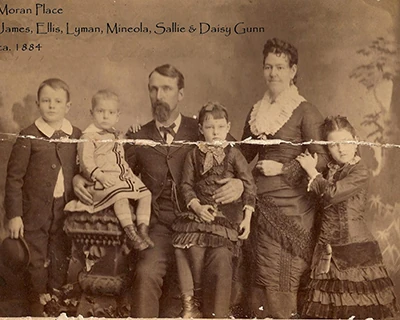
Abby Gunn Baker was born in Pella, Iowa, the daughter of Rev. Elihu and Amy Anna (Barrett) Gunn. Her father was one of the pioneer home missionaries of the Baptist faith to Iowa. Her early girlhood was spent in Lawrence and Atchison, Kan., and she was educated at Monticello Seminary, Godfrey, Illinois, and the Kansas State University, at Lawrence.
December 27, 1881, she married William Henry Baker of Fort Scott, Kan. In 1896 they settled in Washington, where Mr. Baker entered government service. For a time his work took them into the field and at one period they spent considerable time in Rhode Island.
Soon after coming to the Capital Mrs. Baker became interested in literary work, and her articles have appeared in many papers and magazines throughout the country, in addition to her special stories from time to time in The Star.
Makes Plea for White House Relics
Through one of her articles during the Roosevelt regime, in which she called attention to the necessity of preserving in permanent form the priceless White House relics peculiar to the various presidential administrations, her knowledge of the subject was brought to the attention of President Roosevelt, who summoned her for a conference, which ended in authorizing her to begin a representative collection of the presidential china and plate. In the course of executing this commission Mrs. Baker visited descendants of all the former presidents, and the present collection, arranged in special cases at the White House, is the result of her painstaking effort and her thoroughgoing familiarity with this subject.
She had written extensively about this collection, and a considerable portion of the book upon which she was at work when stricken by her last illness is devoted to its history and to recounting her personal experiences in perfecting the collection. As an authority on White House history she had been widely consulted, not only by occupants of the executive mansion, but by historians and collectors throughout the country.
Leader on Other Lines
In addition to her literary work Mrs. Baker was identified as a leader in many movements of consequence. During the world war she was one of two Washington women who were entitled to wear the Y.M.C.A. insignia in recognition of services in the camps and hospitals. She was actively interested in the work of the American Association of University Women, the College Women’s Club, the Daughters of the American Revolution and the Columbia Historical Society, and had frequently spoken before these organizations.
Within a short time after Mrs. Baker came to Washington to live she became a member of Calvary Baptist Church. She had been president of the Women’s Baptist Missionary Society and at the time of her death was a member of the national board of women’s missionary organizations.
She was largely instrumental in forming the now nationally known Burrall class, composed of a membership of some thousand young women, chiefly among government clerks.
Aids Work for Chinese
Early in her alliance with Calvary Church she became interested in the efforts put forth in connection with the Sunday school for the Chinese, a branch of the school of which Mr. Baker was for many years superintendent. As a lecturer she traveled extensively, particularly in interdenominational work, and a few years ago her tour as a speaker in behalf of the interchurch movement carried her twice across the continent.
Mrs. Baker leaves, besides her husband, a sister, Mrs. G. S. Warn of Hilton, N. Y.; a brother, R. E. White of Wyoming; three nieces, Mrs. Lloyd S. Tenny and Mrs. O. L. Veerhoff, both of Washington, and Mrs. Kenneth Calhoun of Fort Scott, Kansas, and two nephews, Rev. Charles G. Gunn of Winnsboro, S. C., and William Rice Gunn of Kansas City, Mo.
The funeral will be held from Calvary Baptist Church tomorrow, January 27, at 2 p.m.