Letter from President Theodore Roosevelt to Mrs. Abby G. Baker
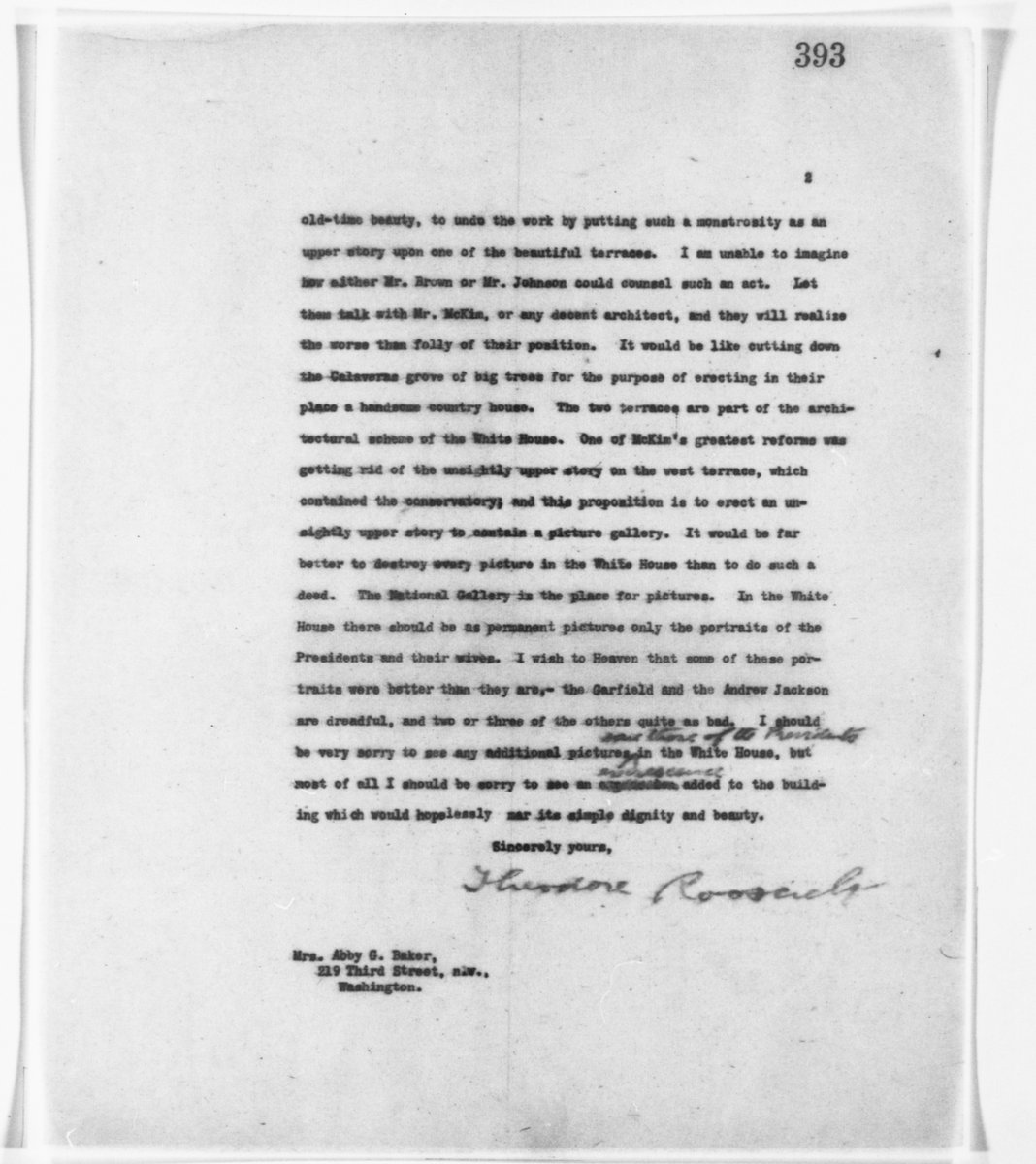
This letter was written by President Theodore Roosevelt on December 5, 1908, addressed to Mrs. Abby G. Baker at 219 Third Street, N.W., Washington. It survives as two typewritten pages numbered 392 and 393 in the Abby Gunn Baker Papers held by the White House Historical Association. Roosevelt's signature is handwritten. Several handwritten editorial corrections appear in the final paragraph of page 2; their wording is not sufficiently clear in the surviving image to warrant conjectural transcription. The letter demonstrates the direct working relationship between Baker and the Roosevelt White House, and Roosevelt's strongly held views on the architectural integrity of the Executive Mansion.
Source: Abby Gunn Baker Papers, White House Historical Association Public Domain
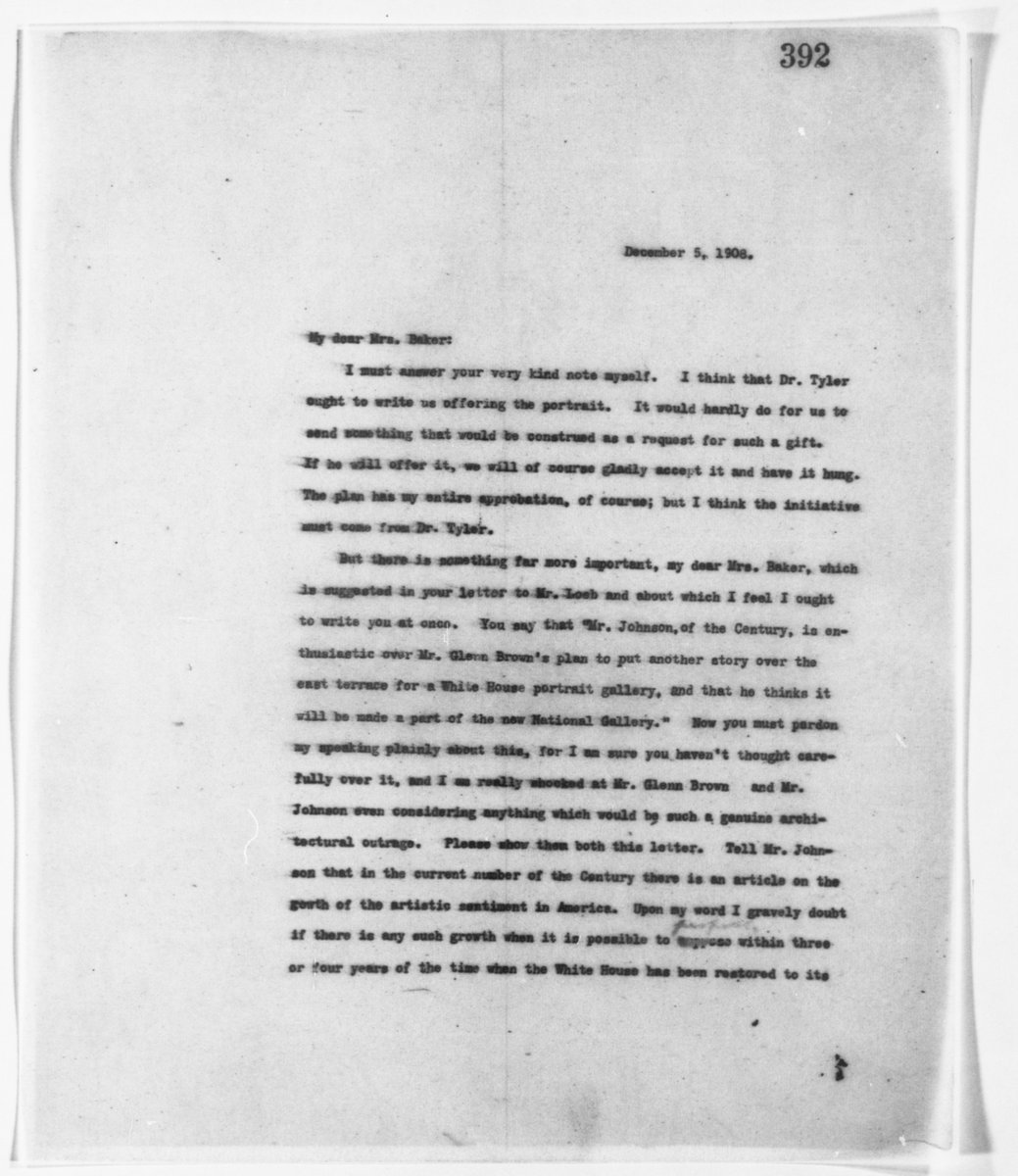
December 5, 1908.
My dear Mrs. Baker:
I must answer your very kind note myself. I think that Dr. Tyler ought to write us offering the portrait. It would hardly do for us to send something that would be construed as a request for such a gift. If he will offer it, we will of course gladly accept it and have it hung. The plan has my entire approbation, of course; but I think the initiative must come from Dr. Tyler.
But there is something far more important, my dear Mrs. Baker, which is suggested in your letter to Mr. Loeb and about which I feel I ought to write you at once. You say that “Mr. Johnson, of the Century, is enthusiastic over Mr. Glenn Brown’s plan to put another story over the east terrace for a White House portrait gallery, and that he thinks it will be made a part of the new National Gallery.” Now you must pardon my speaking plainly about this, for I am sure you haven’t thought carefully over it, and I am really shocked at Mr. Glenn Brown and Mr. Johnson even considering anything which would be such a genuine architectural outrage. Please show them both this letter. Tell Mr. Johnson that in the current number of the Century there is an article on the growth of the artistic sentiment in America. Upon my word I gravely doubt if there is any such growth when it is possible to propose within three or four years of the time when the White House has been restored to its old-time beauty, to undo the work by putting such a monstrosity as an upper story upon one of the beautiful terraces.
I am unable to imagine how either Mr. Brown or Mr. Johnson could counsel such an act. Let them talk with Mr. McKim, or any decent architect, and they will realize the worse than folly of their position. It would be like cutting down the Calaveras grove of big trees for the purpose of erecting in their place a handsome country house. The two terraces are part of the architectural scheme of the White House. One of McKim’s greatest reforms was getting rid of the unsightly upper story on the west terrace, which contained the conservatory; and this proposition is to erect an unsightly upper story to contain a picture gallery. It would be far better to destroy every picture in the White House than to do such a deed. The National Gallery is the place for pictures. In the White House there should be as permanent pictures only the portraits of the Presidents and their wives. I wish to Heaven that some of these portraits were better than they are, — the Garfield and the Andrew Jackson are dreadful, and two or three of the others quite as bad. I should be very sorry to see any additional pictures in the White House, but most of all I should be sorry to see an [handwritten correction indistinct] added to the building which would hopelessly mar its simple dignity and beauty.
Sincerely yours,
Theodore Roosevelt
Mrs. Abby G. Baker, 219 Third Street, n.w., Washington.