The Hampshire Colony
The Hampshire Colony
The Beginning of Princeton—The Killing of Phillips by the Indians.
The Death of Aaron Gunn, Who Was in the Cabin When Phillips Was Shot.
[LaSalle Daily Tribune.]
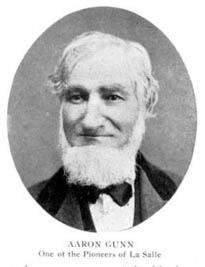
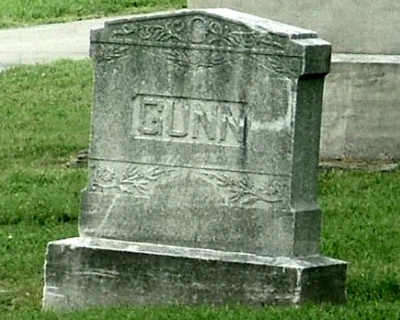
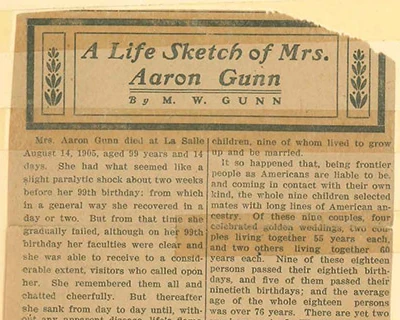
Aaron Gunn, who died at his home, 1174 Creve Coeur street, La Salle, Illinois, March 12, 1897, has been since the fall of 1870 La Salle’s earliest living settler. He was taken with la grippe Feb. 14, and, on account of his great age, his system was not able to recover itself after the disease had run its course; and he gradually sank till life’s flame went out.
Aaron Gunn was born in the town of Montague, Mass., on the banks of the Connecticut river, 90 miles west of Boston, on the 4th day of April, 1806, and, had he lived 23 days longer, would have seen his 91st birthday. He was of Scotch descent, and the name Gunn is still common in certain parts of the Scottish highlands. The founder of the family in America was, probably, Jasper Gunn, a physician, who came to America from County Kerry, in the ship Defence, in 1635. One of his descendants, Nathanial Gunn, was one of the original proprietors of the town of Montague, and in the town cemetery eight generations of the Gunn family lie buried. They were a long lived race, his father being one of eight brothers, the youngest dying at about 65 years of age; all the rest passed the age of seventy; one reached 100, another 96; his father died in his 88th year.
At the age of 24 Aaron Gunn determined to see the great west; and, in the fall of 1830, made a trip to central Michigan. He was so well pleased with the country that he determined to return home and make arrangements to find a permanent home in the west. Sometime in the spring of 1831 he learned of a colony styled “the Hampshire colony,” the aim of which was to establish a settlement in Illinois. He joined this colony at Albany, N. Y., about two weeks after hearing of its existence and object. The fall before, the colony had sent an agent to look up a suitable location. The agent, upon his return, reported in favor of the head of navigation on the Illinois river; from which point it was expected that a canal would be eventually built to Lake Michigan.
The colony left Albany, N. Y., via Erie canal, on the 7th day of May, 1831, and arrived at Buffalo May 17. There they learned that there were no boats that went around the lakes to Chicago (then Fort Dearborn) and were compelled to content themselves with taking shipping for Detroit. At Detroit they learned that only one small schooner had sailed around the lakes to Fort Dearborn, the summer before. This same schooner they found already loaded and ready to sail on its first trip in 1831, and being already loaded, she could take neither them nor their baggage. As it would cost more to stay in Detroit and wait the return of the schooner than to travel overland to Lake Michigan, they stored their baggage at Detroit, except things for immediate need, and arranged with the schooner to make a second trip to carry their goods to Fort Dearborn. They then hired teams to haul themselves overland to Lake Michigan.
In the colony were eight young unmarried men, who had only their trunks to carry. Their names, in the order of their age, were as follows: John Leonard, John P. Blake, Aaron Gunn, Amos C. Washburn, Christopher G. Cross, George Hinsdel, E. Hinsdel Phelps and Charles C. Phelps. These eight boys hired a four-horse team to take them across the country. After passing White Pigeon prairie, one horse in the team died, another was taken sick, the other two not being able to haul the load. At Mottville, seven of the boys, Washburn staying with the colony, at the suggestion of Gunn, bought two Indian dugouts of the Indians, lashed them together, side by side, launched them on the St. Joseph’s river, loaded in their baggage, and paddled down the river to its mouth. Here they found a French Indian trading post, kept by one Curteaus—the site is now South Bend, Ind. Here they hired a man with an ox team to haul their canoes and baggage across the country six or eight miles to the Kankakee river, arriving there at sundown, June 1.
They then launched their boats on the Kankakee and paddled down to LaSalle, then Illinois town, landing on the 9th day of June, 1831, at a point just below the mouth of the Big Vermillion, where a man by the name of Crozier was keeping an Indian trading post and the first postoffice in La Salle county, called Shippingport. He was the father of the late Amasa Crozier, of Utica. Amasa was a lad, playing on the banks of the river when the boys landed, and well recollected the event. There were at that time 150,000 people in the state of Illinois, most of them in the southern part of the state. There were then at La Salle, three white men and one white woman, namely: Samuel Lapsley, who built a sawmill at the present site of the Matthiessen & Hegeler pumping station on the Little Vermillion; he died there in 1839. Burton Ayers, who was a blacksmith, and ran the only blacksmith shop between South Ottawa and Peoria, and became one of our most prominent citizens, and died there in the fall of 1870. And John Foynder and wife, who, after some years, returned to Indiana.
Among the eight young men of that colony, seven of whom landed from the dugouts, the first death occurred 33 years after the landing. At the end of 65 years five of them were still living, and those five all passed the age of 80 years, with a possible doubt of a few months in regard to the age of Washburn. Two of them passed their 90th birthday. One still survives, E. Hinsdel Phillips, of Roseland, Adams county, Nebraska; he was then a boy of 18; Dec. 31, 1896, he was 84. These men were all of Puritan descent. All, with a possible exception of one or two, were converted Christian men in early manhood; were always temperate in their habits, and adopted total abstinence in regard to alcoholic drinks soon after the movement started.
A few days after the arrival of the colony, it was thought desirable to secure a supply of cured meats for the summer. Gunn and three others of the boys took the dugouts and proceeded down the river as far as Peoria, then Fort Clark. There they found one and one-half barrels of pickled pork for sale and bought out the town. This not being deemed sufficient, they dropped down twelve miles farther to Pekin, where they succeeded in securing several hundred pounds of bacon; with all of which they then returned to the colony, who were then located, for the time being, at Lowell, now in Eden township, which was a smart town for those days.
The colonists were not pleased with the LaSalle site and scattered somewhat, the body of them going to Princeton. Had they located at LaSalle, their influence in bringing eastern capital and settlers here would, no doubt, have made LaSalle the largest city in the state, except Chicago. Gunn made no definite settlement for the summer, but in the spring of 1832, he, with Daniel Dimmick, father of the late Elijah Dimmick, of Dimmick township, settled at LaMoille, then known as Dimmick Grove.
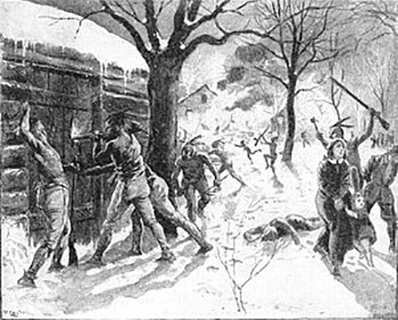
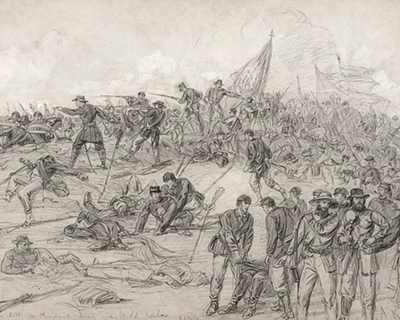
On the 19th of May they received notice that Black Hawk and his band were on the warpath and they started without delay for Hennepin, where was a fort and a considerable white settlement; and the river lay between them and the hostile Indians. Here he enlisted in a militia regiment under Col. John Strawn, of Peoria. A few days after his enlistment, a man by the name of John Ament came to Hennepin to try to secure a squad of men to go with him to his cabin near Princeton and get his household goods, which he had left when he fled from the Indians. He got six men to volunteer, making a company of seven in all. Among the number was Aaron Gunn, Sylvester Brigham; Ziba Dimmick, a brother of the late Elijah Dimmick, then a boy of 16, and a young man by the name of Phillips, who had a cabin near Ament’s. The boys knew nothing of Indian warfare and pursued their way in the most unguarded manner; in fact, they thought Black Hawk and his band so far from the neighborhood that there was no danger. Arrived at Ament’s cabin in the evening, they scattered around without precaution, Phillips going to his cabin to write a letter. At night, finding the door broken from its hinges they propped it up with puncheons from the floor and lay down to sleep without even the precaution of setting a guard. In the night they heard what they innocently supposed were birds around the house. In the early morning Phillips started for his cabin to finish his letter, expecting the boys to have the wagon loaded by the time he got back. He had gone but a few rods from the door when he ran onto a group of about thirty Indians skulking in the brush, evidently waiting for the company to come out and begin loading the wagon, when they could bring them all down at one volley. Phillips turned to run for the cabin, and was instantly shot down by the Indians. They, seeing that their hiding place was discovered rushed onto the body of Phillips and tomahawked him in the most savage manner, and then made a dash for the cabin. Aaron Gunn and Sylvester Brigham each grasped a gun with a fixed bayonet, and one standing on each side of the doorway, put their muskets through the cracks of the propped up door, and leaning against the doorway of the cabin crossed their bayonets in the middle of the doorway. The Indians seeing the glittering bayonets and supposing that all within were ready for action, dared not make the charge, and rushed into a thicket on the other side of the cabin, hiding there, as the boys supposed, to watch their opportunity to pick off any one who should expose themselves. The fact was that Gunn and Brigham were the only ones in the cabin who had got their guns in their hands. Ziba Dimmick had been asleep through it all; but soon awakening and realizing the situation, began, boy like, to cry; then he proposed to run. Gunn, knowing that anything of that kind would indicate to the Indians a panic in the cabin, said to Dimmick: “You run out of this house and I will shoot you as quick as I would an Indian.” Dimmick stopped at that. After a time Gunn said to Dimmick, who was willing to do anything to get away from such a place: “There are horses outside and there is corn and a bridle in the house; if we can coax one of those horses with some corn to put his head into the door, and slip a bridle on him while he is eating corn, will you mount him and ride to Hennepin for help?” “Yes,” said Dimmick, glad of any chance to escape. No man in that cabin would have dared to mount that horse. Gunn said to him: “When you mount, ride with all your might a mile out into the open prairie to get clear of the Indians skulking in the timber; then turn and ride for Hennepin.” Soon the boys had a horse bridled. Dimmick mounted in a moment and rode at full speed out into the open prairie. When he was safely a mile away, every man in the cabin said: “I wish I was on that horse,” and they no doubt spoke the truth when they said it. And then when the first crisis had passed, and dim hope of life began to dawn, Gunn was probably the only man in the cabin whose nerve did not utterly fail him—and Gunn confessed afterward that his knees shook. Brigham, a man of iron nerve, broke down and wept like a child. He said: “This is my 25th birthday; I have always said it should be my wedding day, and now I am to be married to death.” Gunn said to him: “It is no use to cry; of course we shall all be killed, but we must defend ourselves and sell our lives as dearly as we can.”
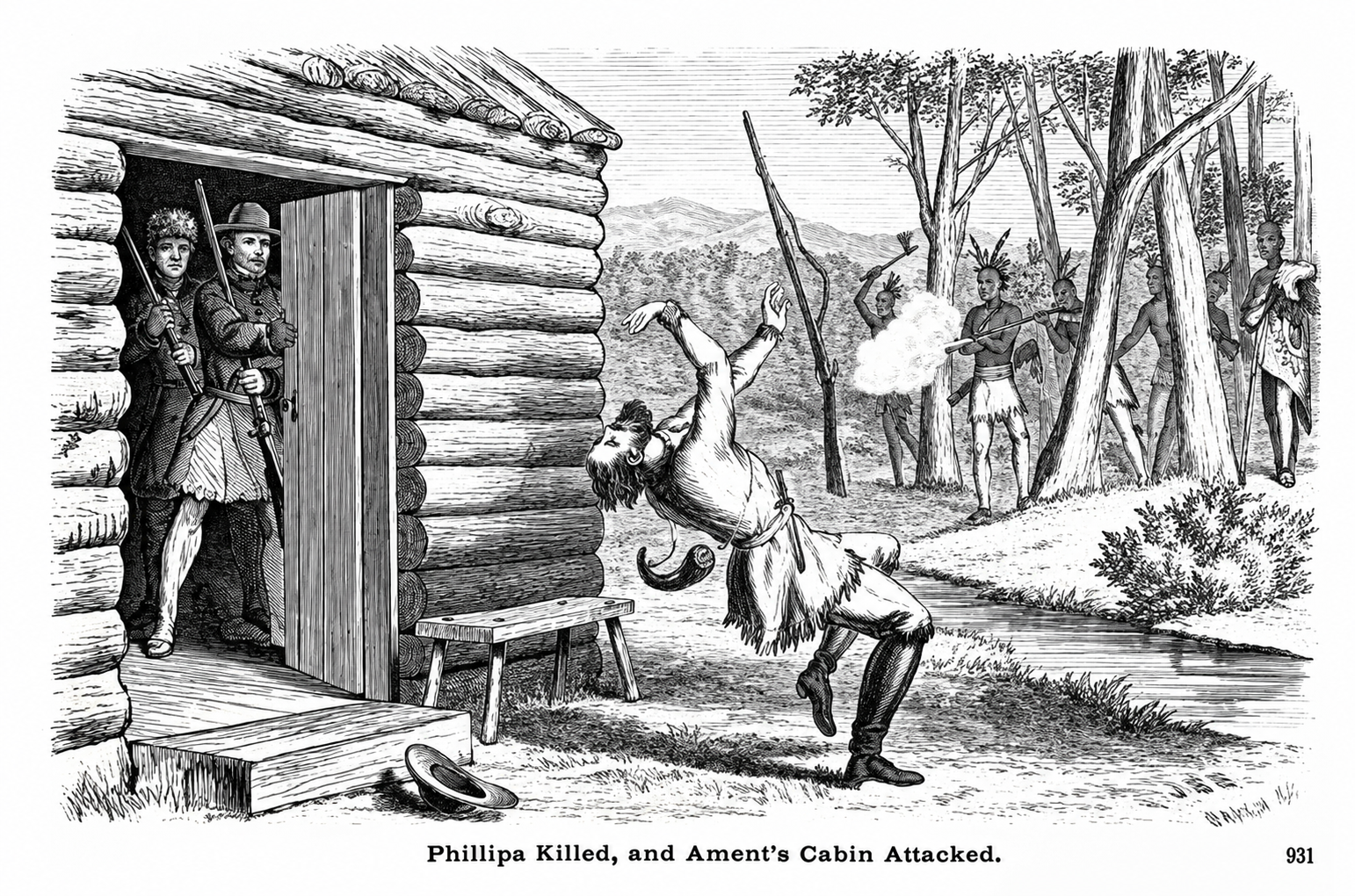
Illustration: “Phillipa Killed, and Ament’s Cabin Attacked.” Engraving, artist unknown, first published in 1878 in Nehemiah Matson’s Memories of Shaubena; reappeared in the 1887 edition.1
Gunn was always an excitable man, easily upset by trifles, but in moments of great difficulty, loss or peril, his coolheadedness, courage and good judgment were never known to fail him. I particularize somewhat in this, because Mr. Matson, in his history of Bureau county, gives John Ament the credit of standing with Brigham at the door of the cabin; whereas the fact is Gunn was the hero of the hour.
Dimmick, after getting well out on the prairie, headed for Hennepin with all speed, where he arrived safely about 11 o’clock; and when he told his story, all was excitement among the settlers. Immediately 75 mounted men were started to the rescue; and by 4 o’clock in the afternoon, the boys were gladdened by the sight of their comrades coming to their relief. The wagon was loaded, and taking the body of Phillips with them, they returned to Hennepin. The Indians made no appearance after going into the thicket, from the cabin door. They probably concluded to give up the job after failing in their attempt to make a surprise, and, knowing that U. S. regulars were north of the river, thought best to get out of a possible trap; and so, after watching the cabin for a time got out of the way.
Phillips was buried the next day, and was the first white man buried at Hennepin, the county seat of Putnam county. Gunn also helped to bury the first white man at Princeton, the county seat of Bureau county, and preached the funeral sermon at the first interment in Rockwell cemetery, the body being that of the father of the late Esq. James Clarke, of Utica. Gunn was for many years the last survivor of the band at Ament’s cabin. After twenty-nine days’ service, Col. Strawn’s regiment of militia was mustered out of service, and Aaron Gunn with them. The Black Hawk war scattered the Hampshire colony to various parts of the country. Gunn sold his claim at La Moille to a man by the name of Bowen, father of Col. Bowen of Mendota, and made another claim in Putnam county, not far from the present Quaker’s Yearly Meeting House. This claim he sold to Joseph Hovle, the first Quaker settler in the Clear Creek neighborhood.
In 1835 he entered the west half of section 10, town of La Salle, which afterwards became the site of his home for nearly 60 years. While living in Putnam county he was converted, in 1833, under the labors of a Cumberland Presbyterian preacher by the name of Mitchel. Mitchel had a farm in Sangamon county, which he cultivated in the summer, and spent his winters preaching to the settlers on the frontier. Gunn’s conversion made a radical change in his character. He ever after set before him as life’s greatest object, life’s highest aim, that of making a better humanity, in himself, and human life around him. He had a life-long abiding faith in Jesus Christ as a person and a power to lift the world’s manhood, by bringing men nearer to God. He was no great stickler for creeds, though he had his beliefs. He believed that men must become partakers of the divine nature before they could surely rise to a higher manhood.
He was a Baptist in belief, but there being no Baptist organization in the neighborhood he joined the Methodists. Preachers were scarce in those days, and the Methodists perceiving his zeal, and that he had some capacity as a public speaker, set him to preaching. He preached among the Methodists for several years, mostly as a local preacher. But one year he rode the circuit which extended as far east as Morris, as far north as Dixon, and back to the neighborhood of Hennepin. He always retained many pleasant memories of his associations with the Methodist brethren.
On the 14th day of May, 1837, he was married to Miss Nancy Winters, lately from Ohio. Few people have been united in marriage whose aims in life have been in more perfect harmony. Had he lived 63 days longer, they would have celebrated the 60th anniversary of their marriage. The widow who survives him will be 91 next July. Seven children blessed this union, five of whom survive him, namely, Mrs. G. A. Elliott, M. W. Gunn and Mrs. T. A. Williams all of this city. Also Mrs. H. B. Chapman and Mrs. F. L. Ayers of Augusta, Kan. In the fall of 1862 they took into their family a pair of twin babies, seven months old, who were born on their silver wedding day; they also survive him—the boy, C. W. Bradley, of Spring Valley; the girl, Mrs. Harry Turner, of Fifth street, LaSalle.
Aaron Gunn lived near Magnolia one year after his marriage; but in the early part of 1838 he built a log cabin on his farm at LaSalle, and on the 15th day of May moved, with his wife and baby—now Mrs. G. A. Elliott—into his log cabin on the farm where he was to spend the rest of his days. The widow and Wm. Maloney, now living near the west end of Fifth street, are now the only survivors in the township who came here previous to 1840.
He was always a preacher; was the first protestant preacher who settled in LaSalle. He did much preaching among the settlers and made his home a place of free entertainment for preachers of all orthodox denominations. When the Baptists organized a church here, about 1845, he was one of the constituent members. That was the first protestant church organized in LaSalle. Previous to that time he had worked mainly with the Presbyterians in Peru. When the Methodists organized here in 1851, he took a great interest in the movement and boarded their first pastor seven months without charge. He continued to preach the gospel, but as the churches were organized and pastors settled, he seemed to feel that there was less and less need for his services in that line, and, since he became 80 years of age, seldom made public addresses of any kind, although his interest in the moral progress of those around him continued to the end of life. When he had ceased to interest himself in secular affairs, he still held on to his ever deep interest in man’s moral elevation. He always took sides against oppression in any form. In early days he was an ardent abolitionist. In political associations he was always for the right, regardless of prospects for victory or defeat. His charities extended to all without regard to beliefs or nationality. He treated all men as though they were fully equal to himself and considered none unworthy of his consideration. He always had a heart of sympathy and a hand of help for the needy and suffering around him. His was a life largely filled with self-sacrifice, and the moral impress of his life on the community by which he was surrounded cannot but be deep and lasting.
M. W. GUNN.
LaSalle, Ill., Mar. 23, 1897.
Source citation: M. W. Gunn, “The Hampshire Colony,” Bureau County Tribune (Princeton, Illinois), April 2, 1897, p. 4; credited in the clipping to the LaSalle Daily Tribune; signed at LaSalle, Illinois, March 23, 1897. Newspapers.com, https://www.newspapers.com/image/613045226/.
Transcription note: Paragraphing and line-end hyphenation have been normalized for readability. Historical wording and apparent inconsistencies are retained. In particular, the clipping gives Gunn’s birth year as 1806 but calls his approaching birthday his 91st; it lists “E. Hinsdel Phelps” among the travelers but later names “E. Hinsdel Phillips.” The printed route description also places the mouth of the St. Joseph’s River at South Bend. These statements have not been silently corrected. The surname “Hovle” is transcribed as it appears in the clipping. Period descriptions of Native people reflect the author’s perspective.
Endnotes
Footnotes
-
The engraving was first published in 1878, in Nehemiah Matson’s Memories of Shaubena: Incidents Relating to the Early Settlement of the West (Chicago: D. B. Cooke & Co., 1878), which was copyrighted and first printed that year; it reappeared in the 1887 edition. The artist is unknown or uncredited. Sources: AbeBooks listing for Memories of Shaubena; Wikipedia file page, “Attack at Ament’s Cabin”; digitized copy of Matson, Memories of Shaubena (1887 ed.), Northern Arizona University digital collection. ↩
