



Family Members in This Story
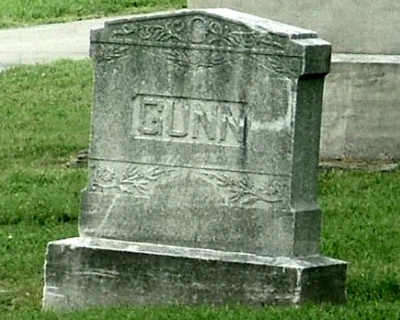
- George Almon Gunn — Private, Co. I, 67th Ohio Volunteer Infantry — killed at Deep Bottom, August 16, 1864
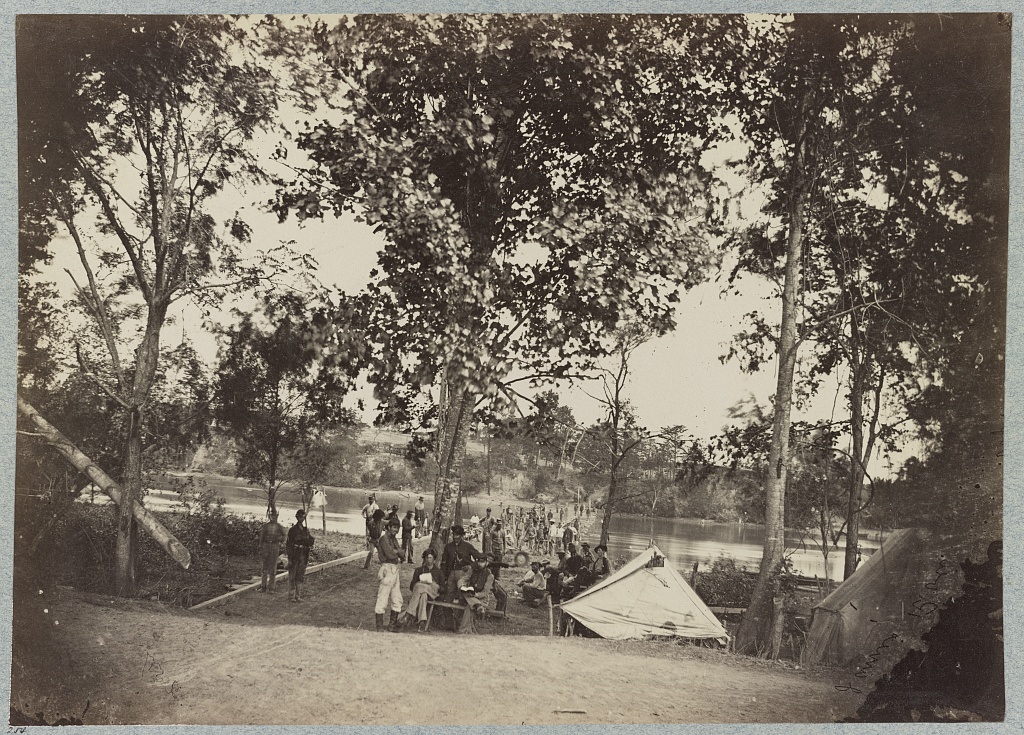
Deep Bottom is a bend on the James River in Henrico County, Virginia, a few miles below Richmond. It had no particular significance before the summer of 1864, when Union engineers threw pontoon bridges across the river there and turned it into a fortified bridgehead — a foothold on the north bank that Federal forces used, and reused, for the rest of the Siege of Petersburg. Twice that year the ground around it erupted into full-scale battle, and it was there, in the second of those battles, that George Almon Gunn was killed.
A bridgehead, not a battlefield
By July 1864, Ulysses S. Grant had abandoned any hope of destroying Robert E. Lee’s army in the open field. After the bloodletting at Cold Harbor, his strategy shifted to strangulation: pin the Army of Northern Virginia at Petersburg, cut its rail lines, and force Richmond into starvation. But Petersburg’s defenses were strong, and Grant needed a way to draw Confederate troops away from those lines without another frontal assault. Deep Bottom became his answer — a place to threaten Richmond directly, forcing Lee to divide his already-thin army between two fronts.
First Battle of Deep Bottom (July 27–29, 1864)
On the night of July 26, Maj. Gen. Winfield Scott Hancock crossed the James at Deep Bottom with the Union Second Corps and two divisions of Philip Sheridan’s cavalry. The next day, Union infantry attacked Confederate positions along River Road and captured four cannon. Lee responded quickly, rushing two divisions north to reinforce the lines at New Market Heights and Fussell’s Mill. A Confederate counterattack near the Darby house on July 28 stalled the Federal advance, and Hancock recrossed the river on July 29, leaving a garrison to hold the bridgehead.
Tactically the fighting favored the Union, at a cost of roughly 488 casualties to the Confederacy’s 679. Strategically it did exactly what Grant needed: it pulled Confederate strength away from Petersburg just before the Battle of the Crater.
Second Battle of Deep Bottom (August 13–20, 1864)
Three weeks later, Hancock returned to the same ground with a much larger force — the Second and Tenth Corps and a division of cavalry, some 28,000 men in all — again aiming at Richmond’s defenses while a second Union column struck at the Weldon Railroad near Petersburg. The fighting concentrated around Fussell’s Mill and Bailey’s Creek. On August 16, Union troops briefly broke the Confederate line before a counterattack drove them back out; Confederate cavalry general John Chambliss was killed in the fighting along Charles City Road. By August 20, Hancock had withdrawn.
This round was bloodier — nearly 2,900 Union casualties against about 1,500 Confederate — and is usually scored a Confederate tactical victory. As a diversion, though, it again succeeded, tying down men Lee could not spare.
It was during this second battle, on August 16, that the fighting reached the 67th Ohio Volunteer Infantry, part of the Army of the James.
George Almon Gunn
Private George Almon Gunn, Company I, 67th Ohio Volunteer Infantry, had enlisted on September 11, 1862, at the age of thirty-eight, leaving behind a wife and children in Ohio. His regiment’s road to Deep Bottom was a long one — the siege lines before Charleston in 1863, then back to Virginia in the spring of 1864 for Maj. Gen. Benjamin Butler’s Bermuda Hundred operations against Richmond and Petersburg.
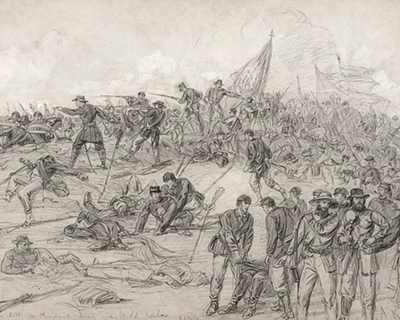
By mid-August 1864 the 67th Ohio had moved north of the James to Deep Bottom as part of Hancock’s second demonstration there. On August 16 — the same day Union troops briefly broke through near Fussell’s Mill — four companies of the regiment charged Confederate rifle pits and suffered heavy losses in the first volley before taking the position. George Gunn was among the dead.
The Ohio military roster records simply:
George Gunn — Private, Company I, 67th Ohio Infantry. Enlisted September 11, 1862. Killed August 16, 1864, at Deep Bottom Run, Virginia.
He had served for nearly two years. His nephew Henry Gunn, serving alongside him, later wrote home to George’s widow, Rhoda, describing what happened — a letter that, if it survives, would be one of the most important documents connected to this branch of the family. George’s fuller story, including his family, his regiment, and the unresolved question of his eventual burial place, is told on his own page.
A third action nearby
A related operation followed on September 29–30, 1864, when Union forces broke through nearby at Fort Harrison, expanding the bridgehead the two Deep Bottom battles had first established. Fort Harrison would later be recorded, somewhat puzzlingly, as George Gunn’s burial place — a detail that postdates his death by six weeks and remains unresolved.
A note on the image
The photograph above shows the pontoon bridge at Deep Bottom itself, photographed during the war and held by the Library of Congress (Prints and Photographs Division, LC-DIG-ppmsca-33355), which lists no known restrictions on publication. It is one of several surviving period views of the crossing; the Library’s own collection, along with related holdings at the National Gallery of Art and the Metropolitan Museum of Art, has other candidates if a different vantage or composition is wanted.
Sources & Notes
- American Battlefield Trust, "First Battle of Deep Bottom" and "Second Battle of Deep Bottom," battlefields.org
- Wikipedia, "First Battle of Deep Bottom" and "Second Battle of Deep Bottom"
- Official Roster of the Soldiers of the State of Ohio in the War of the Rebellion and Roll of Honor of Ohio Soldiers, entry for George Gunn, Co. I, 67th Ohio Infantry
- Frederick H. Dyer, A Compendium of the War of the Rebellion, regimental history of the 67th Ohio Infantry
- Library of Congress, Prints and Photographs Division, LC-DIG-ppmsca-33355