Dr. Moses Gunn (1728–1793)
Physician, Selectman, and Voice of the Revolution | Montague, Massachusetts
Family
- Born: 12 October 1728, Sunderland, Massachusetts Bay Colony
- Died: 3 January 1793, Massachusetts
- Parents: Deacon Nathaniel Gunn (1693–1779) and Esther Belden
- Grandfather: Deacon Samuel Gunn (1662–1755)
- Great-great-grandfather: Dr. Jasper Gunn (1607–1671)
- Brother: Lt. Nathaniel Gunn Jr. (1726–1807), the branch point of the direct line followed in The Gunns in America
- Spouse: Eleanor Ingram (1754–1814), married 1790
- Education: Yale College, class of 1748
- Occupation: Physician; tutor early in life
- Offices: Montague selectman (1761–1784, intermittently); delegate to the Massachusetts Provincial Congress, 1774–1775
- Known for: Author of Montague’s April 1773 reply to the Boston Committee of Correspondence
If Some Men Carried Muskets
Moses Gunn carried arguments. He was a physician by trade and a town officer by habit, and in the years before the Revolution he became one of the clearest political voices in the upper Connecticut Valley. He worked in meetinghouses, committees, and legislative assemblies, not on a battlefield.
In 1910 the Montague historian Edward Pearson Pressey called him “our Samuel Adams, our spokesman throughout the Revolution.”1 The comparison is generous, but it is not empty. Gunn did for one small town what Adams did for the colony: he put the grievances into words that his neighbors could read, argue over, and act on.
Family and Early Life
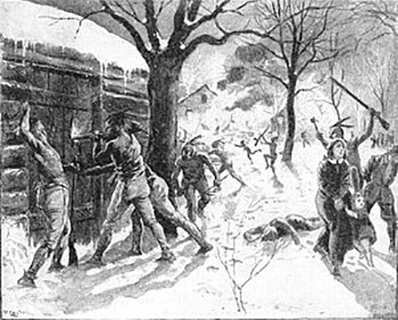
Moses was born in Sunderland on 12 October 1728, the son of Deacon Nathaniel Gunn and Esther Belden, daughter of Stephen Belden and Mary Wells of Hatfield.2 His grandfather Deacon Samuel Gunn had helped settle Sunderland and had survived the 1677 attack on Hatfield. His great-grandfather Nathaniel was a son of Dr. Jasper Gunn, who came to Milford, Connecticut, in 1639. Deacons ran through the family. Moses grew up where religion, schooling, and public duty were one subject.
He was the second son to carry the name. An older Moses, born in October 1727, died the following month, and the name went to the next boy.3 His surviving siblings were Nathaniel Jr. (1726–1807), Asahel (1730–1796), Elisha (1733–1769), and, in some genealogies, a sister Esther born in 1736. Nathaniel Jr. became a lieutenant in the militia and a deacon, and he sat beside Moses on Montague’s Committee of Correspondence.
Yale and Medicine
Moses graduated from Yale in 1748 at about twenty.2 The curriculum was classical languages, logic, rhetoric, and moral philosophy, which was also the working vocabulary of eighteenth-century political argument. After graduation he tutored in the Hudson River region, then returned to western Massachusetts and set up practice in Montague.
His medical training is not documented. Dexter records the Yale degree, not a medical one, and local records simply call him Dr. Gunn. That was ordinary for the period, when most physicians learned by apprenticeship and practice. What the record does show is a man the town trusted. A country doctor went into every kind of household, knew who was sick and who was poor, and heard what people said when they were worried.
Montague and Family
Montague was incorporated in 1754, carved out of the district called Hunting Hills, where the Marsh, Gunn, and related families had cleared land a generation earlier. Moses settled into that network of Connecticut Valley families.
Compiled genealogies give his wife as Eleanor (Elenor) Ingram (1754–1814) and the marriage as 17 June 1790 in Montague.4 Moses was sixty-one; Eleanor was about thirty-six. Two children are named in published family accounts: Gustavus Adolphus Gunn (born about 1790), who later settled in Illinois and is linked to the Hampshire Colony migration to Bureau County, and Elizabeth Ingram Gunn, who married Samuel Preston. Moses died less than three years after the marriage, so both children were very young when they lost him. Accounts say they lost their mother as well. Marriage, probate, and household records have not yet been checked.
Selectman
Montague’s roster lists Dr. Moses Gunn as selectman in 1761–1762, 1765, 1767, 1769, 1771, 1774–1779, and 1782–1784.5 Selectmen ran the town’s business, including roads, schools, taxes, and disputes, and they did it while earning a living some other way. Two decades of repeated election is a measure of local confidence. It was also his apprenticeship in representative government. A town meeting was where Montague’s people argued about taxation and authority long before Parliament made those arguments urgent.
The Gathering Crisis
After 1763, Britain sought revenue and tighter control in the colonies, and many Massachusetts towns read the new policies as an attack on established rights. The dispute was less about the amount of tax than about whether Parliament could bind people who had no representatives in it.
On 21 September 1768, Montague’s inhabitants met in their meetinghouse and chose Gunn to represent the town at a proposed convention in Boston.1 Seven years as selectman had made him the man the town sent beyond its own boundaries.
The Committee of Correspondence
Boston began organizing the Committees of Correspondence in 1772 to let towns share grievances and coordinate responses. On 6 April 1773 Montague voted to form its own. The seven men chosen were Moses Gunn, Moses Harvey, Elisha Allis, Stephen Tuttle, Peter Bishop, Judah Wright, and Nathaniel Gunn Jr.1 The meeting adjourned to 20 April, when the committee was to bring its answer to Boston.
Gunn wrote it. The letter begins with the rights the colonists held as Christians, British subjects, and human beings, and it treats liberty of conscience, security of property, and the protection of law as rights that government exists to preserve. It objects to a Parliament three thousand miles away legislating for colonies that had no voice in it, and it challenges general warrants as contrary to English law. Its argument is constitutional, not separatist. Gunn is not demanding independence in 1773. He is claiming the rights of Englishmen.
It was read at the Montague town meeting on 20 April, and by Pressey’s account the assembly asked to hear it read again.1 Gunn had taken what the town already felt and made it an argument it could defend.
Read an excerpt from the letter in Voices.
In March 1777, with the war under way, Montague named a new three-man committee: Deacon John Gunn, Dr. Moses Gunn, and Sergeant Nathaniel Smith.
The Provincial Congress
By autumn 1774 the Massachusetts Government Act had curtailed town meetings and the charter, and Governor Gage had moved to keep the legislature from meeting. The elected representatives met anyway and formed the Massachusetts Provincial Congress, an alternative government at the moment the royal one was failing.
Lincoln’s published journal lists the delegate from Montague to the First Provincial Congress in October 1774 as “Deacon Moses Gunn.”6 Montague returned him to the Congress that met at Cambridge on 5 February 1775. That spring, Sunderland and Montague jointly chose Captain Israel Hubbard and Dr. Moses Gunn as delegates to the Congress at Watertown.7 The Congress had no secure treasury and no standing army. It authorized militia companies, took up supply and public safety, and built an authority independent of the Crown. Gunn was part of that work from the beginning.
The War
His documented service in the war was political and administrative, not military. No verified record shows Dr. Moses Gunn of Montague as an officer, soldier, or surgeon in the Continental Army or the militia. Other men of the name did serve, among them a younger Moses Gunn (born 1756) of the Westfield minutemen, and those records should not be attributed to the physician without evidence.8
His town did mobilize. A company of minutemen answered the alarm of 19 April 1775, and a second assembled on 22 April, with Asahel Gunn and Samuel Gunn among its men.9 That month Montague also voted to send an ox-drawn wagon of flour, pork, peas, tobacco, and oats to feed them.9 Selectmen and delegates like Gunn raised the money, collected the taxes, and kept the supplies moving, so that the men who marched had something behind them.
The New Republic
Gunn served as selectman through 1784. Biographical accounts also credit him with service in the Massachusetts General Court in 1775, 1780, and 1790.2 That span runs from the colonial government through the 1780 state constitution to the first years under the federal one. He was born a subject of the Crown and died a citizen of a republic whose first president was in his first term. The questions he argued in 1773, about taxation, representation, and limits on authority, did not end with independence. They moved into the new institutions, and he stayed in them.
Religion
The Gunns were a deacon family, and the Congress journal calls Moses “Deacon.” Whether that reflects an office he held, and in which congregation, is not established (see Research Notes). His 1773 letter reasons from Christian obligation as well as from English law, which was ordinary among New England patriots. His authority in Montague came less from piety than from decades of service to his neighbors.
Death
Moses Gunn died 3 January 1793, aged sixty-four.2 Nothing in the sources I have seen describes his last illness. His burial place and estate remain to be traced through Montague cemetery records and Hampshire County probate.
Legacy
Pressey’s 1910 history remembered him for his command of language, his steady service, and his commitment to representative government.1 His influence was local, but the principles were national. Montague did not need him to tell it that taxes were heavy and distant authority was dangerous. What he supplied was the case: grievances placed in the tradition of English constitutional rights, and resistance framed as the defense of an inheritance rather than disloyalty.
Jasper Gunn had practiced medicine, taught, and served his church in the first settlements. A hundred and forty years later, Moses carried the same combination of learning, medicine, and civic duty into the Revolution. The century had changed, but the habit of service had not.
He did not command troops or win battles. He argued the case, and then he helped build the institutions to sustain it.
The River found its voice.
Sources and Endnotes
Research Notes
Identity cautions. Two other Gunns bear the name or title. A Moses Gunn, husband of Olive Carver, appears in Montague accounts of this period (John Warner Barber, Historical Collections, transcription concerning Montague; full title to be confirmed). Sgt. Moses Gunn, grandson of Nathaniel Jr., is a separate man covered elsewhere on this site. Keep every record tied to Dr. Moses Gunn of Montague until the identification is checked.
“Deacon Moses Gunn.” Lincoln’s journal uses the title, but Deacon John Gunn (1707–1793) was active in the same town in the same years, and no record yet shows Moses holding the office. Treat the title as unverified.
General Court service. The 1775, 1780, and 1790 terms come from Dexter. John Gunn also served in the General Court for Sunderland, so match each term to its man against the Journals of the House.
Parents. Esther Belden’s death date is not established. Some compiled sources give 1779, the year of her husband’s death.
Marriage and children. The date 17 June 1790 follows the working genealogy used on the Nathaniel Gunn (1693–1779) page. Confirm against the Montague vital record, along with the children’s birth dates and the fate of their mother.
Nathaniel Jr. An earlier draft called him a Baptist deacon. That is not in the sources cited on the site, so this page says only “deacon.”
The 1773 letter. Check the wording of any quotation against the original printed transcription before it goes into the Voices edition.
Footnotes
-
Edward Pearson Pressey, History of Montague: A Typical Puritan Town (Montague, MA: New Clairvaux Press, 1910), 122–26. Describes Gunn’s selection for the 1768 convention, the 1773 Committee of Correspondence and his letter, and his reputation as the town’s spokesman. ↩ ↩2 ↩3 ↩4 ↩5
-
Franklin Bowditch Dexter, Biographical Sketches of the Graduates of Yale College, with Annals of the College History, vol. 2, May 1745–May 1763 (New York: Henry Holt and Company, 1896), entry for Moses Gunn, class of 1748. ↩ ↩2 ↩3 ↩4
-
Charles E. Gunn, The Gunns, genealogical account of the descendants of Jasper Gunn, p. 69. Identifies Moses’s parents and siblings and records the death of an earlier child named Moses in 1727. ↩
-
“Hampshire Colony Biographies,” Bureau County, Illinois, Genealogy and History, entry for Gustavus Adolphus Gunn. Compiled account naming Gustavus and Elizabeth Ingram Gunn as children of Moses and Eleanor Ingram Gunn. Original marriage and birth records not yet verified. ↩
-
“Selectmen of Montague, 1756–1910,” transcribed from Montague records, Franklin County, Massachusetts Genealogy and History. Lists Dr. Moses Gunn’s years as selectman. ↩
-
William Lincoln, ed., The Journals of Each Provincial Congress of Massachusetts in 1774 and 1775, and of the Committee of Safety (Boston: Dutton and Wentworth, 1838), 10. Lists “Deacon Moses Gunn” for Montague at the First Provincial Congress. ↩
-
John Montague Smith, History of the Town of Sunderland, Massachusetts, Which Originally Embraced Within Its Limits the Present Towns of Montague and Leverett (Greenfield, MA: E. A. Hall & Co., 1899), 126; Pressey, History of Montague, 127. Document Gunn’s election to the Provincial Congress in 1775. ↩
-
Massachusetts Soldiers and Sailors of the Revolutionary War, vol. 6, p. 952, entry for Moses Gunn of Westfield. Compare the younger Moses Gunn (born 1756); nothing establishes this as the record of Dr. Moses Gunn of Montague. ↩
-
Pressey, History of Montague, 127–28. Montague minutemen in April 1775 and the town’s provisioning of the companies. ↩ ↩2