



Nathaniel Gunn
The Narrow Passage Between Two Generations
Family
- ParentJasper Gunn
- ParentChristian Gunn
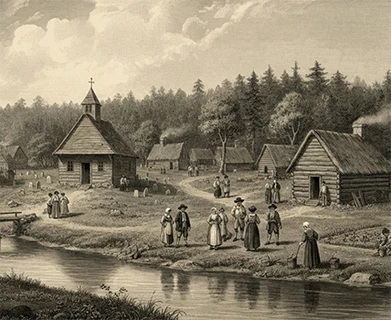
Nathaniel Gunn was born about 1640, the son of Dr. Jasper Gunn and Christian Gunn. His childhood unfolded during the first unsettled decades of English colonization in New England, as his family moved from Roxbury to Hartford and eventually became associated with the emerging settlement at Milford.
Unlike his father, whose long life left traces in the civic, religious, medical, and commercial records of several communities, Nathaniel had little time to establish a comparable public identity. What survives is the outline of a young man who married, helped establish a household in Branford, and died before reaching middle age.
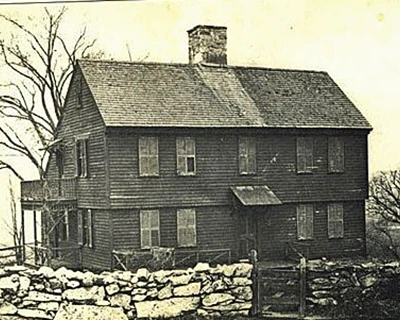
On 17 November 1658, Nathaniel married Sarah Day, daughter of Robert Day and Editha Stebbins of Hartford.1 The marriage joined two families already deeply rooted in the first generation of Connecticut settlement. Nathaniel and Sarah soon made their home in Branford, on the coast east of New Haven.
Nathaniel is included on the Town of Branford’s official list of early founders and settlers.2 His presence there suggests that he participated in the formative life of the community, although the surviving evidence does not yet establish his occupation, property holdings, public offices, or precise date of arrival. He was likely still in his early twenties when he began creating a household of his own.
A Life Cut Short
Nathaniel died at Branford in 1663, probably no more than twenty-five years old.3 The cause of his death is not known. Disease was an ever-present danger in seventeenth-century New England, but no surviving record presently connects Nathaniel’s death to a particular epidemic. His early death nevertheless reflects the fragility of colonial life, when illness, infection, childbirth, accident, and inadequate medical treatment could abruptly alter the course of a family.
Nathaniel and Sarah appear to have had several children, but the surviving genealogical accounts do not agree fully on their names or number. What is clear is that only one son, Samuel Gunn, survived to carry the family line into the next generation.
Born in Branford in 1662 or 1663, Samuel was an infant—or perhaps not yet born—when his father died. He would eventually live until 1755, becoming a deacon, husband, father, and respected member of the Connecticut River Valley communities in which he settled. Through Samuel, the line descending from Jasper Gunn continued into the eighteenth century and ultimately to thousands of later descendants.4
Nathaniel’s brief life therefore occupies a crucial place in the Gunn family story. He did not live long enough to leave a substantial public record, but the survival of his son created a narrow passage between generations. Had Samuel not survived, one of the principal lines descending from Jasper Gunn would have ended almost as soon as it began.
Sarah Day Gunn Kellogg
After Nathaniel’s death, Sarah Day Gunn married Samuel Kellogg on 24 November 1664. She moved with him to Hatfield, Massachusetts, where they established a new household and had additional children.5 Samuel Gunn appears to have grown up within this blended family.
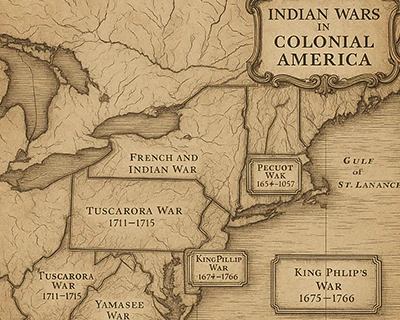
The Connecticut River Valley was then an expanding frontier of English settlement, bordered by Native homelands and increasingly strained by land disputes, political instability, and warfare. Those tensions erupted during King Philip’s War, fought from 1675 to 1676, and continued in localized attacks after the principal organized resistance had collapsed.
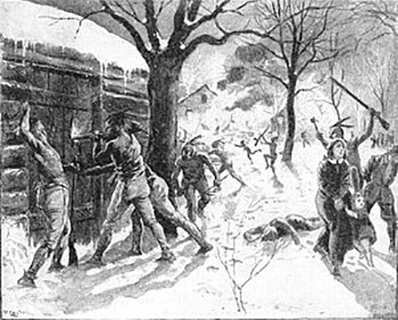
On 19 September 1677, Hatfield was attacked by Native warriors. Sarah was killed, together with her young son Joseph Kellogg. Other residents were killed, wounded, or taken captive.6 Samuel Kellogg Jr., another of Sarah’s children, was carried north toward Canada before eventually returning.
The attack left the surviving Gunn and Kellogg children without their mother. For Samuel Gunn, who had already lost his father in infancy, Sarah’s death was a second defining loss. Yet he survived, reached adulthood, and became the living connection between the family established by Jasper Gunn and the generations that followed.
The Narrow Passage
Nathaniel Gunn’s importance lies less in the number of records he left than in the consequences of his short life. Between Jasper Gunn’s arrival in New England and Samuel Gunn’s long adulthood stood a period of extraordinary vulnerability: an early death, uncertain childhood survival, remarriage, migration, and frontier violence.
Samuel’s survival was not inevitable. It was the narrow passage through which this branch of the Gunn family continued.
Nathaniel’s story reminds us that family continuity often depends not upon celebrated achievements but upon quieter and more precarious events—the formation of a household, the birth of a child, and the survival of one generation long enough to create the next.
Timeline
- c. 1640 — Nathaniel Gunn is born, probably in Massachusetts or Connecticut, to Jasper Gunn and Christian Gunn.
- 17 November 1658 — Marries Sarah Day, daughter of Robert Day and Editha Stebbins.
- By the early 1660s — Settles in Branford, Connecticut Colony, where he is remembered among the community’s early founders and settlers.
- 1662 or 1663 — Birth of his son Samuel Gunn.
- 1663 — Nathaniel dies at Branford while still a young man.
- 24 November 1664 — His widow, Sarah, marries Samuel Kellogg.
- 19 September 1677 — Sarah and her young son Joseph Kellogg are killed during the attack on Hatfield, Massachusetts.
- 1 August 1755 — Nathaniel’s surviving son, Deacon Samuel Gunn, dies at Sunderland, Massachusetts, after carrying the family line into a new century.
Family
Parents
- Dr. Jasper Gunn (1607–1670/71)
- Christian Gunn (c. 1615/16–1690)
Wife
- Sarah Day Gunn Kellogg (c. 1640–1677), daughter of Robert Day and Editha Stebbins
- Married Nathaniel Gunn on 17 November 1658
- Married Samuel Kellogg on 24 November 1664
- Killed at Hatfield, Massachusetts, on 19 September 1677
Children
The number and identities of Nathaniel and Sarah’s children vary among later genealogical compilations and require further confirmation from Branford and Connecticut vital, church, land, and probate records.
The securely identified surviving child is:
- Deacon Samuel Gunn (1662/63–1755), who married Elizabeth Wyatt and carried the principal Gunn line into the Connecticut River Valley.
Related Reading
- Dr. Jasper Gunn: Physician, Teacher, and Founder
- Christian Gunn: A Life Across the Atlantic
- Deacon Samuel Gunn: Survival and Continuity
- The Narrow Passage: How One Family Line Survived
- The Attack on Hatfield, 1677
- Disease and Mortality in Colonial New England
Research Notes
Nathaniel’s precise year and place of birth remain uncertain. Published and online genealogies variously place his birth between approximately 1637 and 1640.
His inclusion on Branford’s founders list is documented, but a future research pass should examine Branford town, land, church, and probate records before assigning him a specific occupation, landholding status, military role, or civic office.
Nathaniel’s cause of death is also unknown. Although epidemic disease was common in colonial New England, his death should not be attributed to an epidemic without documentary evidence.
The children attributed to Nathaniel and Sarah differ among compiled genealogies. Primary records should be used to establish which children belonged to Nathaniel Gunn and which were born after Sarah’s marriage to Samuel Kellogg.
The Joseph killed with Sarah during the 1677 Hatfield attack was Joseph Kellogg, her young son by her second husband. He should not be identified as Joseph Gunn.
Endnotes
- Compiled genealogical accounts consistently give the marriage of Nathaniel Gunn and Sarah Day as 17 November 1658. Sarah was the daughter of Robert Day and Editha Stebbins of Hartford. The exact recording jurisdiction and original manuscript source should be verified against Connecticut vital and church records.
- Town of Branford, Connecticut, “Founders of Branford,” official municipal history page. Nathaniel Gunn appears among the town’s recognized founders and early settlers.
- Nathaniel Gunn’s death is generally placed in 1663 at Branford. Some compiled accounts give a date near 17 November, but the original record should be located before an exact date is adopted.
- Deacon Samuel Gunn was born at Branford in approximately 1662 or 1663 and died at Sunderland, Massachusetts, on 1 August 1755. He was the surviving son through whom this branch of the Gunn family continued.
- Sarah, widow of Nathaniel Gunn, married Samuel Kellogg on 24 November 1664. Their children included Samuel, Nathaniel, Ebenezer, and Joseph Kellogg.
- The Hatfield attack occurred on 19 September 1677. Contemporary and later historical accounts identify Sarah, wife of Samuel Kellogg, among those killed. Her young son Joseph Kellogg was also killed, while other residents were taken captive.
Editorial Note: Smallpox and the Gunn Family
The proposed sidebar titled “Smallpox in New England, 1689–1690” should not yet be attached to Nathaniel’s biography. The dates and family connections require additional verification.
A severe smallpox epidemic is well documented in Boston and parts of New England in 1677–1678, when more than two hundred deaths were reported in Boston. Smallpox remained a recurring danger throughout the colonial period, but a specific “major New England outbreak of 1689–1690” should not be asserted without stronger documentation.
The deaths of four children of Mehitable Gunn Fenn and the possible connection between smallpox and the death of Dr. Abel Gunn in 1688/89 should be researched separately through Milford and Wallingford vital records, family genealogies, church records, and regional histories before publication.